Silver
Silver by the Pound: How to Buy a Pound of Silver in 2026
Quick answer: A standard pound of silver is 14.5833 troy ounces, because the pound everyone uses for groceries and shipping (the avoirdupois pound) is heavier than the troy pound of 12 troy ounces. Silver is sold by the troy ounce, so check which pound a seller means. Coins and bars both work. Cash purchases are reported by the dealer above $10,000, and gains on sold coins can be taxed at up to 28%.
A pound sounds like a simple unit, and for silver it is not. Two different pounds are in use, and the gap between them is large enough to change what you pay by more than a fifth. This guide explains the arithmetic, shows what a pound looks like as coins and bars, covers storage, tax and paperwork, and lists the mistakes that cost first-time buyers the most. Everything here is general information about how the metal is measured and reported, not a recommendation to buy.
A note on how we work: Gold & Silver IRA Guide is an independent publisher with no affiliate links on this page. No company on this site was tested or ordered from by us, and the ranking comes from the weighting described on our ranking page.
Pound or troy pound: the 21.5% trap
Silver, gold and the other precious metals are priced by the troy ounce. The troy system also has a pound, and it is the odd one out. NIST Handbook 44, Appendix C, defines 12 troy ounces as 1 troy pound. The same handbook lists 1 avoirdupois pound as 453.592 grams (the exact figure is 453.59237 grams), and 1 troy ounce as 31.103 grams. The avoirdupois pound is the one on the bathroom scale and the postage scale.
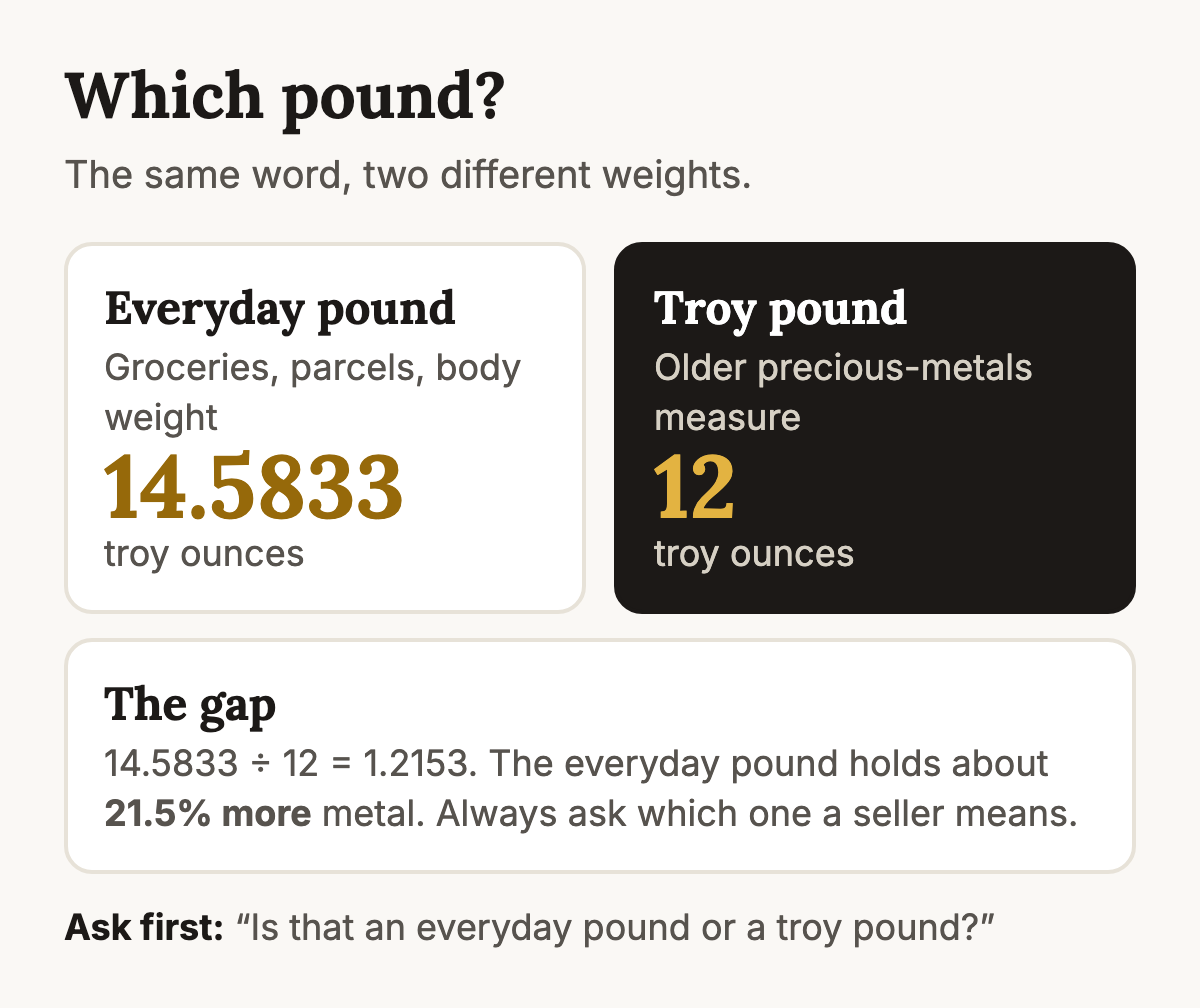
Divide one by the other and you get the number that matters:
453.59237 grams ÷ 31.1034768 grams per troy ounce = 14.5833 troy ounces
So an avoirdupois pound of pure silver holds 14.5833 troy ounces. A troy pound holds 12. The troy pound is lighter: 12 troy ounces weigh about 373.242 grams, which NIST also lists.
Here is the gap, worked out:
14.5833 ÷ 12 = 1.2153
The avoirdupois pound contains about 21.5% more silver than the troy pound. Put another way, a seller who quotes "a pound" using the troy definition is selling 2.5833 fewer ounces than a buyer who expects a shipping-scale pound.
The formula
Keep this in your notes:
- Troy ounces in a pound of silver (avoirdupois): 14.5833
- Troy ounces in a troy pound: 12
- Price of a pound = price per troy ounce × troy ounces in that pound
A worked example, with a round price
The price below is a labelled round number chosen to make the arithmetic easy. Example only, not a current price.
Say silver were $30 per troy ounce:
- An avoirdupois pound: 14.5833 × $30 = $437.50
- A troy pound: 12 × $30 = $360.00
- Difference: $77.50, before any extra charge on top of the metal price
If a listing says "1 lb silver" and the price looks low next to others, the seller may be counting the troy pound. Ask for the weight in troy ounces and in grams. Those two numbers settle the question.
Purity is a second adjustment
The numbers above assume pure metal. Most bullion silver is .999 fine, meaning 999 parts in 1,000 are silver. A pound of .999 silver therefore contains about 14.5833 × 0.999 = 14.569 troy ounces of actual silver. The difference is small, but it is the reason sellers and buyers talk about "fine ounces" and "gross weight" separately. Gross weight is everything on the scale. Fine weight is the silver in it.
What a pound of silver looks like
Very few products weigh exactly a pound. Silver comes in pieces sized in troy ounces or in metric units, so a pound of silver is usually a pile of mixed pieces that add up to near 14.58 troy ounces. These are the common building blocks.
One-ounce coins and rounds
A one-ounce coin holds one troy ounce, which is 31.103 grams. A pound is therefore 14 coins plus a little more than half a coin. In practice nobody sells you half a coin, so you choose between 14 coins (14 troy ounces, a bit under a pound) and 15 coins (15 troy ounces, a bit over).
The arithmetic for 15 coins: 15 × 31.1034768 = 466.55 grams, which is 1.029 avoirdupois pounds. Rounds are similar pieces made by private mints rather than a government. They carry no face value and no government backing, which affects how easy they are to resell and, for a retirement account, whether they qualify. The IRS names one-ounce silver coins minted by the Treasury and certain highly refined bullion as the exceptions to its ban on collectibles in an IRA, so check eligibility before you buy anything for that purpose.
Ten-ounce bars
A 10-ounce bar holds 10 troy ounces, or 311.03 grams. One bar plus four one-ounce coins gives 14 troy ounces. Two bars give 20 troy ounces, which is 1.37 avoirdupois pounds (20 ÷ 14.5833).
Kilo bars
A kilogram bar holds 1,000 grams. Divide by the troy ounce: 1,000 ÷ 31.1034768 = 32.15 troy ounces. As a weight it is 2.2046 avoirdupois pounds. If you want about a pound of silver, a kilo bar is more than double it.
Hundred-ounce bars
A 100-ounce bar is 3,110.35 grams, which is 6.857 avoirdupois pounds. It is a good illustration of why troy and avoirdupois numbers confuse people: 100 ounces sounds like 6.25 pounds if you divide by 16, and it is really closer to 6.86.
Large bars
The LBMA, the London trade body that sets the standard for wholesale bars, describes its silver Good Delivery bar as about 1,000 troy ounces. Dividing by 14.5833 shows that this is roughly 68.6 avoirdupois pounds. These are institution-sized bars. They are not a retail product for a pound-sized purchase, but they explain where the smaller sizes get their price reference.
A simple way to build "about a pound"
| Mix | Troy ounces | Grams | Avoirdupois pounds |
|---|---|---|---|
| 14 one-ounce coins | 14 | 435.45 | 0.96 |
| 15 one-ounce coins | 15 | 466.55 | 1.03 |
| One 10-ounce bar + five 1-ounce coins | 15 | 466.55 | 1.03 |
| Kilo bar | 32.15 | 1,000 | 2.20 |
Weights are worked out from the NIST gram values above, rounded to two decimals.
Premium by form
The premium is what you pay above the metal's value. It covers making the item, the dealer's margin and shipping. You see it on the invoice as the gap between the price per ounce you pay and the market price per ounce on that day.
We are not quoting premium figures. They change by the day, by dealer and by order size. What holds in general is the order:
- Smaller pieces tend to carry a higher premium per ounce. Making and handling a one-ounce coin costs nearly as much as a bigger piece, so the cost is spread over less metal.
- Government coins tend to cost more than private rounds, because buyers pay for the recognized design and easy resale.
- Larger bars tend to carry a lower premium per ounce, but they are harder to sell in part and may need assay if they have no maker's seal.
To compare two offers fairly, convert both to a price per troy ounce:
total price ÷ troy ounces received
An example with round numbers, again not a current price: you pay $480 for 15 troy ounces. That is $32 per ounce. If the day's market price in the example were $30, you paid $2 per ounce above it, which is $30 for the whole order. Do this sum for every quote, and include shipping and any insurance charge in the total.
A lower premium is not automatically better. A cheap, odd-looking bar that few dealers want can cost you at resale. The premium on the way in and the discount on the way out are both part of the real cost. Our guide to gold and silver IRA costs explains the types of charge to ask about, in words, because published figures change.
Weight, space and storage
A pound of silver is compact, but not light for its size. In hand it feels like a dense paperweight. Fifteen coins stack into a small tube or a stack that fits in a palm-sized box. Because silver is worth far less per ounce than gold, you need far more physical metal to hold the same dollar amount. A larger purchase can mean many pounds, and that changes the storage question.
For a single pound, these are the realistic options:
- At home. A fire-resistant safe bolted to the floor is common. Check your homeowner's or renter's policy first. Many policies cap coverage for money and precious metals, and the cap can be far below the metal's value. Ask your insurer in writing whether silver is covered and for how much, and whether a separate rider is available.
- A safe deposit box. A bank box protects against theft and fire but not necessarily against loss. Ask the bank whether anything insures the contents, and check your own policy.
- A depository. Companies in the metals business offer storage at an independent vault. Segregated storage means your own bars sit apart. Commingled storage means you hold a claim on a pooled stock of like metal. Ask which one you are getting.
- Inside an IRA. Under IRS rules, IRA metal has to stay in the hands of a bank or an IRS-approved nonbank trustee. You cannot keep IRA silver at home.
Weight matters when you carry or ship. A 100-ounce bar is nearly 7 pounds, and a thousand ounces is nearly 69 pounds. If your plan is large, price the shipping and the insurance before the metal.
Cash or IRA
You can own a pound of silver in two ways, and the paperwork differs.
Cash purchase. You pay, the dealer ships or you pick up, and the metal is yours to keep at home or anywhere else. You can sell it to anyone. There is no custodian and no yearly account charge, but you carry the storage and insurance yourself.
Inside an IRA. A custodian holds the account, and a depository stores the metal. The metal must meet the IRS purity and product rules, and you can't take possession of it without it counting as a withdrawal. The IRS says the law does not permit IRA funds to go into collectibles, and that if you do it anyway, the amount is treated as distributed in that year, which can bring a 10% additional tax if you are young enough for the early-withdrawal rule to apply. Eligible bullion, held by the right kind of trustee, is the exception.
The practical question is whether a pound of silver is even the right size for an IRA. A pound of silver at the example price above is a few hundred dollars. Many companies set a minimum for a retirement account that is far higher, so a single pound often fits a cash purchase. See gold IRA versus silver IRA for what qualifies, how a rollover works and why the minimum matters, and the pros and cons of a gold IRA for the trade-offs of the account itself.
Tax and paperwork
Two rules from the IRS catch new buyers by surprise: how a sale is taxed, and how a large cash payment is reported.
Selling coins and bars: the collectibles rate
IRS Topic 409 says that net capital gains from selling collectibles, such as coins or art, are taxed at a maximum 28% rate. That is higher than the standard long-term rates that apply to stocks. Silver coins and bars held outside a retirement account are treated this way. The 28% is a ceiling, not a flat bill. Your own rate depends on your income, and a loss can offset gains.
What does that look like? An example with made-up round numbers, not a prediction: you pay $400 for silver and later sell it for $500. The gain is $100. At a 28% maximum rate, tax on that gain would be at most $28. Keep your purchase invoices. Without them you cannot show what you paid, and the gain is calculated from that cost.
Your dealer may also have its own reporting duties for certain sales. Ask about it, and ask a licensed tax professional who is not paid on the sale how your own situation works.
Paying in cash: Form 8300
The IRS explains that a person in a trade or business who receives more than $10,000 in cash in a single transaction or in related transactions must file Form 8300. The filer has 15 days after the transaction. The filer must also give a written statement to each person named on the form by January 31 of the following year.
For a one-pound purchase this almost never applies, because the amount is far below the line. It becomes relevant for larger orders. Three points:
- The reporting is the dealer's duty, not a penalty on you. A dealer who asks for your tax ID or a form of identification is following the rule.
- "Related transactions" means a series of purchases can be added together. Splitting a payment into smaller parts to stay under the line is a bad idea.
- Ask the dealer in advance which forms of payment count as cash for the form. The IRS page lists the rule, and the dealer's compliance team knows how it applies to your payment method.
General information only. For your own case, a licensed professional who is not paid on the sale is the right person to ask.
Where to buy and what to check
Local coin shops, online dealers and the larger precious metals firms all sell silver. For a single pound, price per ounce and the dealer's reputation matter most. For larger purchases, or for anything going into a retirement account, the following three companies are the ones we compare. Their facts below come from what each company publishes. We did not buy from any of them.
Augusta Precious Metals opened in 2012 and carries an A+ from the Better Business Bureau. Its published minimum is $50,000 for cash or IRA purchases, so it is not the right choice for a one-pound order. It is worth reading for buyers making a much larger purchase who want to learn the process first.
Goldco has been accredited with the BBB since 2011 and holds an A+ rating. It sells gold and silver coins for home delivery and for retirement accounts. It does not publish a minimum, a custodian or a depository on the pages we checked, so ask for all three. It states a buyback policy and says no specific rate is guaranteed.
American Hartford Gold (AHG) has been in business since 2015 with an A+ BBB rating. It publishes a $10,000 minimum for an IRA and does not publish a cash minimum, so ask about a small cash order. It says it cannot legally guarantee to buy metal back, which is a candid statement worth noting. AHG names several depositories.
What to check before you pay
- The unit. Ask for the weight in troy ounces and in grams, not just "a pound."
- The purity. Look for .999 or the stated fineness on the item, and ask for the fine weight.
- The total. Get the all-in price in writing, including shipping and insurance, and divide by troy ounces.
- The product. Name the exact coin or bar. A listing that says only "silver" can mean a thin plated item.
- The return and buyback terms. Ask how the dealer buys back, what it pays and whether a premium applies when you sell.
- The delivery. Ask about tracking, signature and insurance in transit.
- The company. Look up the BBB profile and read complaints and the replies. A record is not a promise, but patterns are informative.
Mistakes to avoid
- Mixing up the two pounds. The most expensive mistake on this page, and the easiest to prevent. Convert to troy ounces first.
- Comparing sticker prices instead of price per ounce. Two quotes for the same "pound" can have different weights, purity and shipping.
- Buying more than you can store or insure. Silver takes space. Decide where it will live before you place the order.
- Forgetting tax records. Keep each invoice with the date, weight and price. You need them when you sell.
- Buying something odd and hard to sell. Familiar coins and bars from known makers are easier to resell than unusual pieces.
- Using a retirement account for a tiny amount. Minimums and account charges can make a small IRA purchase poor value. A cash purchase may suit a pound.
- Taking coins out of an IRA without realizing it is a withdrawal. Check the rules first.
- Reacting to hype. Nobody can say where the price goes next, and neither can we. Treat any promise about the price as a warning sign.
FAQ
How many troy ounces are in a pound of silver?
An avoirdupois pound, the everyday pound, holds 14.5833 troy ounces. A troy pound holds 12. Silver is priced per troy ounce, so confirm which pound a seller means.
Is a pound of silver 12 ounces or 16 ounces?
Neither, in the way people usually mean. The troy pound is 12 troy ounces. The everyday pound is 16 avoirdupois ounces, and each avoirdupois ounce weighs less than a troy ounce, which is why the pound comes to 14.5833 troy ounces.
How much is a pound of silver?
Multiply the price per troy ounce by 14.5833 for a standard pound, then add the dealer's premium and shipping. With the labelled example price of $30 per ounce, that is $437.50 before extras. We do not print live prices on this page, so use a current quote from a dealer.
Is it better to buy silver coins or bars?
Neither is better for everyone. Coins are easier to sell in small amounts and are recognized widely, and they often carry a higher premium per ounce. Bars often cost less per ounce but may be harder to sell in part. Compare the all-in price per troy ounce.
Can I put a pound of silver in an IRA?
Only eligible bullion qualifies, and it must be held by a bank or an IRS-approved nonbank trustee. The IRS says it can't be kept at home. Retirement companies often set minimums, so a small amount may suit a cash purchase better. See our silver IRA company ranking.
Do I pay tax when I sell silver?
Gains on silver coins and bars held outside a retirement account are taxed under the collectibles rules, with a maximum rate of 28% per IRS Topic 409. Your own rate depends on your situation, so ask a licensed tax professional.
Will the dealer report my purchase?
If you pay a dealer more than $10,000 in cash in one transaction or related transactions, the dealer must file Form 8300 with the IRS. A one-pound order is normally far below that.
General information only. This is not tax, legal or financial advice.
Sources
More guides
 Silver
Best Silver IRA Companies for 2026: What Silver Changes
Silver is bulkier and bought in larger piles than gold. See what that changes and how Augusta, Goldco and American Hartford Gold handle it. Gold IRA
Best Gold IRA Companies for 2026: Matched to Your Situation
Which gold IRA company fits you? Augusta, Goldco and American Hartford Gold compared by starting amount, goal, storage and buyback policy. Gold IRA
Gold IRA vs Silver IRA: A Scorecard to Decide in 2026
Gold, silver or both in an IRA? Score the two metals on price, volatility, storage, liquidity and demand, then see how a split works.Comparing companies? Our ranking sets Augusta Precious Metals, Goldco and American Hartford Gold side by side.
Compare the three companies