Gold IRA
Gold IRA Pros and Cons: Who It Suits and Who Should Skip It
Quick answer: A gold IRA lets you hold approved physical gold inside a retirement account that keeps its usual tax treatment. It suits savers who want a slice of retirement money in metal they can name and count. It is a poor fit for anyone who needs income from the account, has a small balance, or cannot stomach price swings and ongoing charges.
Whether a gold IRA is a good idea depends less on gold than on you. The account has real strengths and real drawbacks, and the same feature can be a plus for one saver and a minus for another. This page lays out both sides in plain terms, then names the readers who are usually better off passing.
Nothing here is a recommendation to buy or to stay away. It is general information to help you decide what to ask, and whom to ask.
What a gold IRA actually is
A gold IRA is a retirement account you direct yourself, and "self-directed" here means the account may to hold something other than the stocks and funds most IRAs hold. In this case it holds physical gold: coins and bars that meet the purity rules the IRS sets.
You do not keep the metal at home. The IRS says gold bullion qualifies only when a bank or an approved non-bank trustee keeps physical possession of it, so a custodian holds the account and the metal sits in an approved depository. Three parties are usually involved: the custodian that runs the account, the dealer that sells you the metal, and the depository that stores it.
You can fund the account with new contributions or by moving money from another retirement account. The yearly contribution limit for 2026 is $7,500, or $8,600 if you are 50 or older, according to the IRS announcement of the 2026 limits. Most people who open a gold IRA fund it by rollover or transfer, which is not subject to that annual limit.
The account can be traditional (taxed when you withdraw) or Roth (taxed when you contribute, with qualified withdrawals tax-free). The metal is an ingredient. The IRA is the container, and the container's tax rules come with it.
The pros
You own real metal, not a paper claim
Most retirement accounts hold shares, funds or bonds, which are records of ownership kept in a computer. A gold IRA holds coins and bars with a weight and a purity you can read off a certificate. For some savers, that concreteness is the whole appeal. You can ask where the metal is, what it is, and how much of it there is.
The tax treatment belongs to the IRA
Holding gold in an IRA does not create a separate tax regime. A traditional account defers tax until you take money out, and a Roth account is set up so that qualified withdrawals are not taxed. Compare that with buying gold with after-tax cash, where selling at a profit can create a taxable gain. Which route costs less in tax depends on your income, your age and your plans, and a tax professional can run those numbers for you.
It can add variety to a retirement mix
Diversification means not leaning on one kind of asset. Gold has a history of moving on a different rhythm from stocks and bonds, and some savers like having a portion of their retirement money that does not follow the same drivers. "A different rhythm" is not a promise. There are long stretches when gold has fallen while other assets rose, and the reverse. The point is variety, not protection from loss.
No issuer stands behind the metal
A bond depends on the borrower repaying. A share depends on the company surviving. A bar of gold is not anyone's promise to pay. If a mint, a bank or a company fails, the metal in a depository is still metal. That is a genuine difference in kind, and it is why some cautious savers hold a little of it.
It is worth keeping this honest, though. The metal has no issuer, but the people around it do: the dealer, the custodian and the depository. You are trusting them to do their jobs, which is why their track records matter.
It is tangible and easy to understand
Gold has been used as a store of value for a very long time, and the idea is simple enough to explain in a sentence. A saver who finds the stock market opaque may feel calmer owning something they can picture. Feeling calmer is not nothing. A plan you can stick with through a rough market is worth more than a clever one you abandon.
A few companies spend time on education first
Not every dealer is built around a quick sale. Augusta Precious Metals says its education team hosts a personal web conference covering how gold is priced and which questions to put to any dealer, though that session is offered to retirement savers with $100,000 or more in savings. We have not attended one, and we report only what the company publishes. If you are weighing a gold IRA, a company that teaches before it sells makes the trade-offs below easier to see. Our ranking of gold IRA companies explains how we compared the three we feature, and our About page explains how the site is funded.
The cons
Gold pays no income
A share can pay a dividend and a bond pays interest. Gold pays nothing while you hold it. Any gain has to come from the price rising, and you only realize it by selling. If you want your retirement account to throw off cash, gold will not do that, and the metal's value can sit flat or fall for years.
Price swings are real
Gold's price moves every day, and it can drop sharply. Anyone who bought at a peak has watched it take years to come back. Because you cannot predict where the price goes next, no one can honestly tell you a gold IRA will grow, or that it will protect you. Treat any dealer who talks as though the direction is certain with caution.
Costs exist, and they add up
A gold IRA usually carries several separate costs: a setup charge, an annual charge from the custodian, a storage charge from the depository, and the dealer's markup over the spot price when you buy. A spread between buying and selling prices also applies when you sell. Each is small on its own terms. Together they sit on top of your balance every year, whatever gold does.
Rather than print numbers that go stale or vary by company, we cover the structure in our guide to gold IRA costs and how to get them quoted in writing. The habit worth building here is simple: get every charge in writing before you move money.
The selling spread
Dealers buy at a lower price than they sell. That gap, called the spread, means a gold coin you buy today is usually worth less to the dealer who sells it back to you tomorrow, even if the market has not moved. For a short-term plan, the spread alone can erase a good deal of any gain. For a long-term hold, it matters less, but it never goes away.
It also helps to know that no company can promise to buy your metal back at a set price. Goldco says it will repurchase metal it sold you whenever you ask; its "highest price" pledge only starts after three years, and no rate is guaranteed. American Hartford Gold (AHG) says it cannot legally guarantee a repurchase and asks clients to contact it first when selling. Augusta says it has never declined a buyback, and also that this is not guaranteed and the policy can change. Those are three honest ways of saying the same thing: plan on selling at the market, not at a promise.
The IRS sets rules about what you can hold
Not every gold item can go in an IRA. The tax code treats most coins and metals as "collectibles," which an IRA may not acquire. The exceptions are narrow. According to the IRS page on collectibles in individually directed accounts, they cover certain gold, silver and platinum coins described in federal law, coins issued under state law, and gold, silver, platinum or palladium bullion of a certain fineness when a bank or approved trustee keeps physical possession.
The practical result is that rare or "numismatic" coins, which dealers sometimes pitch for their collector value, can fall outside the rules. If an account acquires a collectible, the IRS treats it as a distribution in the year of acquisition. The amount is taxed as ordinary income and may carry an extra 10% tax if you are under 59½. Before you buy any specific coin or bar, confirm in writing that it qualifies, and let your custodian confirm it too.
Storage rules limit your control
Because the metal must be held by a custodian, you cannot keep it in a home safe or a safe-deposit box and still call it an IRA. Some savers like gold specifically because they can hold it. In an IRA you cannot. The metal sits in a depository, you receive statements, and you ask your custodian for any change.
You may also face a choice between commingled storage, where your metal is held with other customers' metal of the same type, and segregated storage, where yours is kept apart. Segregated is usually a premium option. Ask which one is the default and what the alternative involves. AHG, for instance, says storage is commingled by default and segregated on request.
Taking the metal out
The IRS rules on withdrawals apply to gold the same way they apply to cash. According to the IRS page on early distributions, a 10% additional tax generally applies to distributions from traditional and Roth IRAs taken before age 59½, on top of regular income tax, unless an exception applies. A withdrawal of physical metal is also a distribution, and the amount counts at its value on the day it leaves the account.
Later in life, required withdrawals matter too. The IRS guidance on required minimum distributions says traditional IRA owners must begin taking them at age 73, and that the amount not withdrawn may face an excise tax of 25%, or 10% if corrected in time. Roth IRAs are not subject to these rules while the owner is alive. If your account is mostly metal, you may have to sell some, or take some out in kind, just to satisfy the rule, in whatever market you happen to face that year.
Complexity
A stock IRA can be opened in minutes with one firm. A gold IRA involves a custodian, a dealer and a depository, plus paperwork for each. Mistakes happen mostly at the handoffs: an indirect rollover that misses its window, a coin that does not qualify, a statement nobody reads. None of this is impossible, but it is more work, and more places to rely on others, than a plain account.
Minimums can keep you out
Companies set their own starting amounts, and they are not small. Augusta publishes a $50,000 minimum for cash or IRA purchases. AHG publishes $10,000 for an IRA. Goldco's minimum is not published on the pages we checked, so ask it directly. If your balance is below the amount a company wants to see, the first cost of a gold IRA is that you may not qualify.
How the pros and cons line up
| Feature | Why some savers like it | Why others do not |
|---|---|---|
| Physical metal | You can name and count what you own | You cannot keep it at home |
| Tax treatment | Follows the IRA's traditional or Roth rules | Gains are not taxed differently because it is gold |
| Different price rhythm | Adds variety to a mix of assets | Not a guarantee, and gold can fall for years |
| No issuer behind it | Not dependent on a borrower or company | Dealer, custodian and depository still matter |
| No income | Nothing to track | No dividends or interest to live on |
| Selling | Gold has a ready market | Spread between buy and sell prices |
| Rules | Clear lines about what qualifies | Some coins are not allowed |
Who should skip a gold IRA
A gold IRA is not for everyone, and saying so plainly is part of being useful. You may be better off skipping it if any of the following sounds like you.
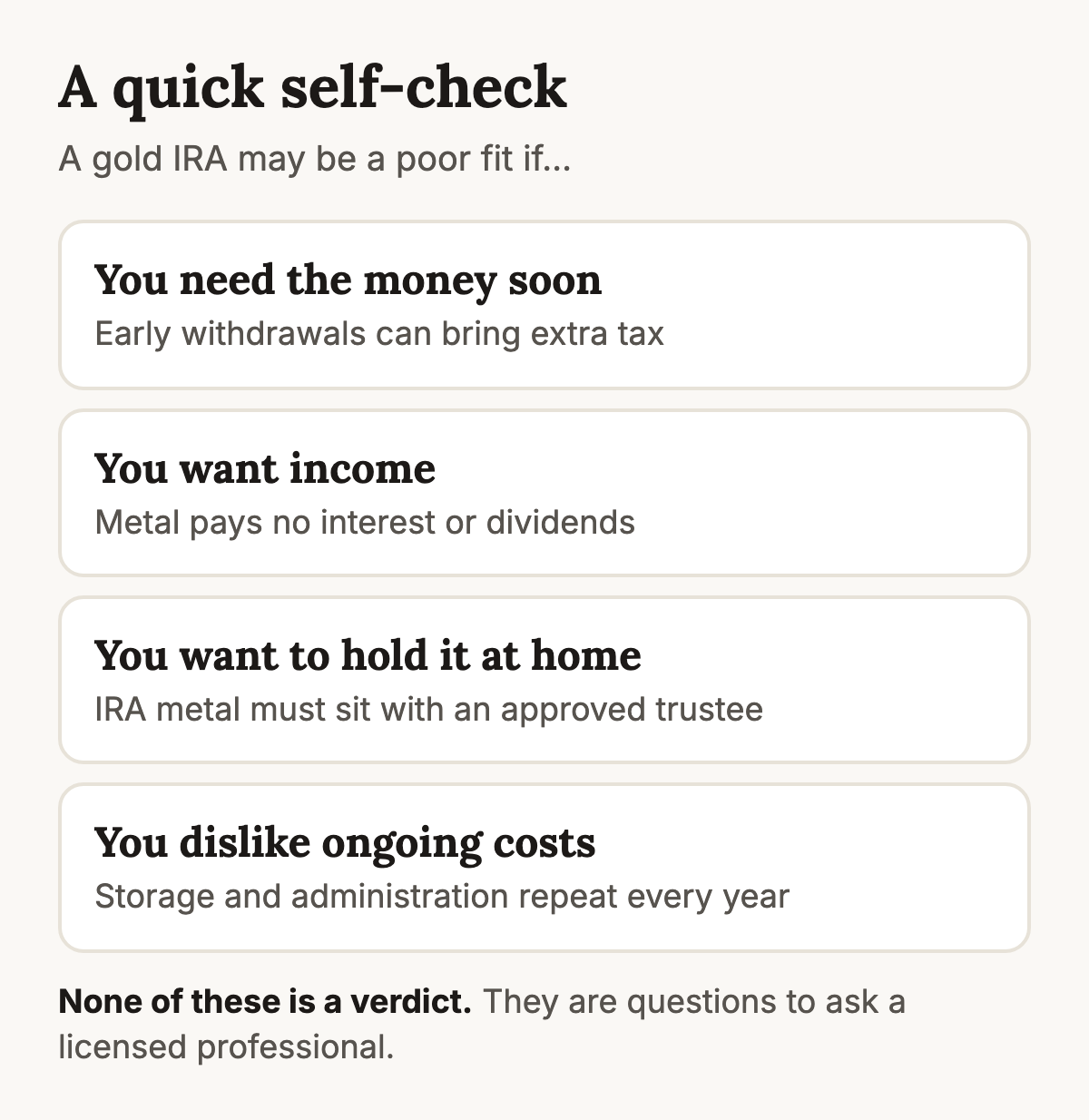
You need income from this money soon. Gold pays no dividends or interest. If you plan to live off the account's payouts in the next few years, metal is a poor match, and required withdrawals could force you to sell at a bad time.
Your balance is small. Setup, annual and storage charges are partly fixed, so they weigh more heavily on a small account. Published starting amounts also run from $10,000 to $50,000 at the companies we feature, so you may not meet them. Our guide to comparing gold and silver IRAs covers what a lower starting amount can look like.
You would sell in a panic. If a 20% drop would send you to the phone to cash out, gold may add stress, not calm. The spread and the early-withdrawal rules make a fast exit expensive.
You want to hold it in your hands. Some people buy gold to own coins they can pick up. An IRA does not allow that. If that is the draw, buying metal with after-tax cash and having it shipped, which some companies offer, may suit you better. Augusta, for example, says cash purchases ship anywhere in the U.S. Our guide to buying gold by the pound looks at the weight and price side of buying outright.
You would be putting in money you cannot leave alone. Gold in an IRA is meant to sit for years. Money you might need for a medical bill or a roof, or money you are tempted to move whenever the news changes, belongs somewhere easier to reach.
You were pushed into it. If someone is hurrying you, scaring you about your bank, or promising returns, stop. Reputable companies explain the downsides. A gold IRA you understand is worth more than one you were pressured into.
Your plan has no room for it. A gold IRA should be a small part of a larger plan, not the plan. If you have not got an emergency fund, a paid-down budget or other retirement savings in place, those come first.
If you are on the fence, a licensed professional who is not paid on the sale can tell you whether any amount makes sense for your situation.
Questions to ask before you start
If you decide to go ahead, you will be in a stronger position with specific answers in hand. Ask each company, and get the answers in writing:
- Who is the custodian, and who is the depository? Companies do not always publish these.
- Which exact coins and bars would be bought, and do they all meet IRS rules for an IRA?
- What are all the charges: setup, annual, storage, and the markup over spot price? What is the price on the day you would sell?
- Is storage commingled or segregated, and what does each cost?
- What is the buyback process, and what does "highest price" actually mean?
- What is the minimum, and does it apply to a rollover, a cash purchase, or both?
- Can you speak with a licensed tax professional before sending money?
For a worked checklist, our guide to gold IRA costs lists the questions in more detail.
If you want to see who stands out on the points above, our ranking of the best gold IRA companies lays out how Augusta (4.9), Goldco (4.8) and American Hartford Gold (4.7) compare. The ranking is editorial, based on a published weighting. We did not order from or test any of them.
FAQ
Is a gold IRA a good idea?
It can be for a saver with a long time horizon, a balance large enough to absorb the charges, and a reason to hold some metal. It is a worse fit for people who need income or may need the money soon. Whether it is good for you is a question for a licensed professional who knows your whole picture.
Does gold protect against inflation?
Gold has risen in some inflationary periods and fallen in others, so it is not a guaranteed hedge. Treat any claim that gold will definitely keep up with prices as a sales pitch. It is one possible ingredient, not a shield.
Can the gold in an IRA be kept at home?
No. The IRS says gold bullion qualifies for an IRA only when a bank or approved non-bank trustee keeps physical possession of it. A gold IRA's metal sits with a depository arranged through your custodian. If you want to keep metal at home, that means buying it outside an IRA.
What happens if an IRA buys a coin that does not qualify?
Under the IRS rules on collectibles, an account that acquires one is treated as having made a distribution in that year. The amount is taxed as ordinary income and may face a 10% additional tax if you are under 59½. That is why you should confirm every coin and bar before the purchase.
Must money come out of a gold IRA at some point?
If it is a traditional IRA, yes. Required withdrawals begin at age 73 under current IRS guidance. A Roth IRA has no such requirement while you are alive. Because the account holds metal, you may need to sell some or take some out in kind to meet the requirement.
Is there any way to get money back if gold falls in price?
No company can promise that. The metal's price moves with the market, and the spread between buying and selling prices means you will usually get less from a dealer than the price you paid. Companies describe their buyback policies, but none can guarantee a price or a repurchase.
How much of a retirement account should be in gold?
That is a personal decision we cannot make for you. A licensed professional who is not paid on the sale can look at your age, income, other savings and tax situation. Be wary of anyone who gives you a percentage without knowing those things.
General information only. This is not tax, legal or financial advice.
Sources
More guides
 Gold IRA
Best Gold IRA Companies for 2026: Matched to Your Situation
Which gold IRA company fits you? Augusta, Goldco and American Hartford Gold compared by starting amount, goal, storage and buyback policy. Gold IRA
Gold IRA vs Silver IRA: A Scorecard to Decide in 2026
Gold, silver or both in an IRA? Score the two metals on price, volatility, storage, liquidity and demand, then see how a split works. Gold IRA
Gold IRA Fees Explained: Every Charge and How to Read It
Where the money goes in a gold IRA: setup, custodian, storage, markup and selling spread. Who charges each, and how to read a quote.Comparing companies? Our ranking sets Augusta Precious Metals, Goldco and American Hartford Gold side by side.
Compare the three companies