Gold
Gold by the Pound: How to Buy a Pound of Gold in 2026
If you want to buy a pound of gold, the first thing to settle is which pound you mean. Gold is weighed in troy ounces, but the everyday pound on a bathroom scale is a different, heavier unit. A pound of gold in the everyday sense holds 14.5833 troy ounces, and you can build it from coins, bars, or a mix of both.
Quick answer: A pound of gold usually means the everyday (avoirdupois) pound, which is 453.59 grams or 14.5833 troy ounces of gold. The old troy pound is only 12 troy ounces. Ask every seller which one a quote uses. You can assemble a pound from 1 oz coins, 10 oz bars and a 1 kg bar. Check purity, storage, paperwork and who buys it back.
Most people who search for gold by the pound are not really after a single object. They want a round, easy-to-remember amount of metal. That is a fine goal, as long as you know exactly how much gold you are paying for. This guide walks through the arithmetic, the forms the metal comes in, and the practical checks that come before any money moves.
Independence: this site carries no affiliate links and takes no payment from Augusta Precious Metals, Goldco or American Hartford Gold (AHG). See how we rank them.
Pound or troy pound: the 21.5% trap
Two different pounds exist, and both are used with gold. The difference between them is large enough to change the price of an order by thousands of dollars.
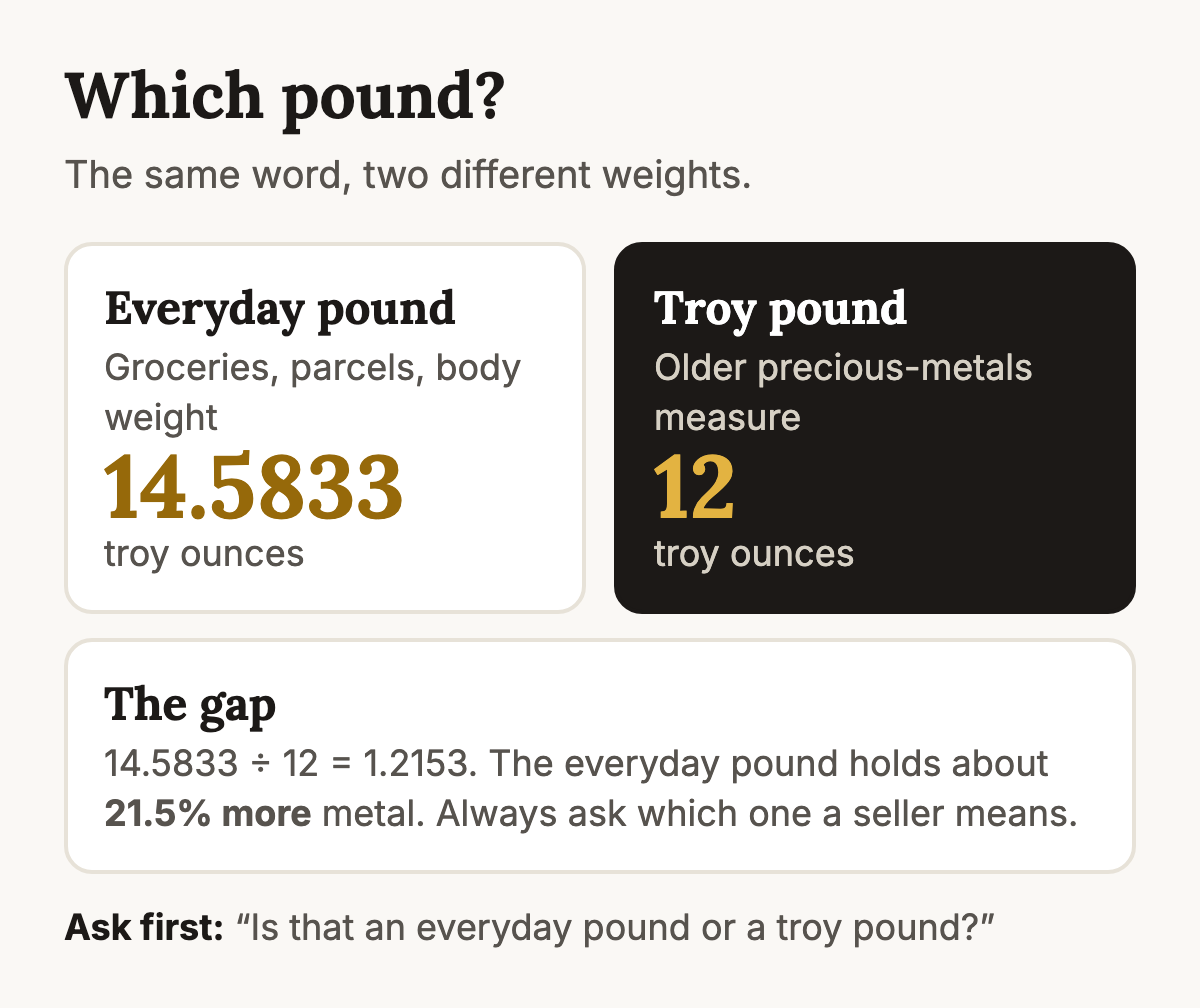
The avoirdupois pound is the one used for groceries, body weight and parcels in the United States. The National Institute of Standards and Technology (NIST) lists it as exactly 7,000 grains. The troy pound is an older measure that survives mainly in the precious metals trade. NIST lists it as exactly 5,760 grains. A troy pound is split into 12 troy ounces, which is why people say a pound of gold is "12 ounces."
Divide 7,000 by 5,760 and you get 1.2153. The everyday pound is about 21.5% heavier than the troy pound. If a seller quotes you a "pound" and means 12 troy ounces, you get less metal than you would expect from a pound on your own scale.
Here is the same comparison in grams, using the conversion factors NIST publishes:
| Unit | Grams | Troy ounces of gold |
|---|---|---|
| Troy ounce | 31.1035 | 1 |
| Troy pound (12 troy ounces) | 373.24 | 12 |
| Avoirdupois pound (the everyday pound) | 453.59 | 14.5833 |
The 14.5833 figure is not rounded off to look neat. It is 453.59237 grams divided by 31.1034768 grams per troy ounce. Written as a fraction, a pound is 14 and 7/12 troy ounces.
There is a second trap inside the first. The word "ounce" also has two meanings. An avoirdupois ounce is about 28.35 grams, while a troy ounce is about 31.10 grams. Every gold price you see quoted is per troy ounce. If you multiply a gold price by 16 (the number of everyday ounces in an everyday pound), you will be wrong twice.
Worked example, using a round number only. Example only, not a current price: suppose gold were $2,000 per troy ounce.
- A pound in the everyday sense: 14.5833 x $2,000 = $29,166.67 of gold.
- A troy pound: 12 x $2,000 = $24,000 of gold.
- The gap between the two: $5,166.67.
The practical rule is simple. Whenever a quote says "pound," ask for the weight in troy ounces and compare that number. Use the example price only to check the arithmetic, then replace it with the live price on the day you order.
What a pound of gold is made of
Nobody sells a single lump of gold weighing a pound. Retail gold comes in standard sizes, and a pound is a pile of them. Here is how the common sizes add up toward 14.5833 troy ounces of pure gold.
One-ounce coins
The most familiar gold coin in the United States is the American Gold Eagle. The U.S. Mint offers it in four sizes: one-tenth, one-quarter, one-half and one ounce. The one-ounce coin contains one troy ounce of gold. The coin itself is not pure gold. It is made to the 22-karat standard, which is 91.67% gold with silver and copper added for durability, so the whole coin weighs 1.0909 troy ounces (33.931 grams) while holding exactly one troy ounce of gold.
That detail matters when you are chasing a pound. Fourteen one-ounce Gold Eagles hold 14 troy ounces of gold. You are 0.5833 troy ounce short of a pound. Adding a half-ounce coin and a one-tenth-ounce coin gets you to 14.6 troy ounces, slightly over.
Do not weigh a pile of Gold Eagles on a kitchen scale and expect 453.59 grams. Fourteen coins weigh about 475 grams on the scale because of the alloy, yet they hold less gold than a pound. Coin weight and gold content are different numbers. Judge by the gold content the mint states, not by the scale.
Other government mints and private refiners sell one-ounce coins and rounds as well. Some are pure gold and some use the 22-karat alloy, so read the stated gold content on each product page.
Ten-ounce bars
A 10-troy-ounce bar holds 311.03 grams of gold. One and a half of them is a little over a pound, but bars are not sold in halves. One 10 oz bar plus four 1 oz coins gives you 14 troy ounces. Add a quarter-ounce coin and a one-tenth-ounce coin and you land at 14.35. You can keep fiddling with small pieces to reach 14.5833, or you can decide that 14.6 or 15 troy ounces is close enough and buy by troy ounce instead.
The one-kilogram bar
A kilogram bar is 1,000 grams. Divide by 31.1034768 and you get 32.1507 troy ounces. In everyday pounds, one kilogram is about 2.2046 pounds, which means a pound is only about 45% of a kilogram bar. So a one-kilogram bar is more than two pounds of gold, not one.
That surprises people who assume a "kilo" is the big, round, near-a-pound size. It is far larger, and at the example price above, a kilogram bar would hold about $64,300 of gold. Few retail buyers start there.
A pound is therefore awkward to hit exactly with the standard sizes. That is not a problem so much as a reason to think in troy ounces from the start.
Purity and weight checks
Before you pay, confirm four things from the product description and the paperwork.
- Gold content in troy ounces. The listing should state it, and it should be the figure you are paying for. On a 22-karat coin it will be lower than the full coin weight.
- Purity. Bars are commonly sold as .9999 or .999 fine. The number is the proportion of gold, so .9999 means 99.99%. Higher is not a reason to overpay, but it should match what the seller advertised.
- Mint or refiner. Gold from a recognized government mint or refinery is easier to resell than an unfamiliar brand. A bar with a clear stamp of weight, purity and maker is easier to verify.
- Packaging and assay card. Many bars arrive sealed with a certificate. Leave the seal intact if you may resell, because a broken seal can slow the sale or lower the price.
Be wary of any seller who will not state weight in troy ounces, who quotes by "the pound" with no unit, or who offers a price that sits well below what established dealers publish. A discount that is too good to be true is usually a counterfeit, a different unit, or a bait offer that changes at checkout. When in doubt, ask for the product's gold content and purity in writing, and walk away if the answer is vague.
Premium by form
Gold is priced from the spot price, then the seller adds a premium to cover minting, handling and profit. The premium is the difference between what you pay and the raw metal value. It is the main cost of owning physical gold, and it varies by form.
In general, small pieces carry a higher premium per ounce than large ones. A one-tenth-ounce coin costs more per troy ounce of gold than a one-ounce coin, which costs more per ounce than a 10 oz bar. Large bars tend to be cheapest per ounce. Government-minted coins, such as the Gold Eagle, often carry a higher premium than bars of the same weight, partly because coins are easier to sell quickly.
Here is a simple illustration with made-up numbers. Example only, not a quote: suppose a seller adds 5% to coins and 2% to bars, and gold is $2,000 per troy ounce.
- One pound of gold in 1 oz coins: $29,166.67 plus 5% is about $30,625.
- One pound of gold in bars: $29,166.67 plus 2% is about $29,750.
- The difference: about $875 on a single pound.
Real premiums move with the market and differ by dealer, so use your own quotes. The lesson holds regardless of the figures: the form you pick changes the cost, and the cheapest form to buy is not always the easiest to sell in small pieces.
There is a trade-off in the other direction. If you ever need to sell part of your gold, a pound made of 1 oz coins can be sold in pieces, while a single large bar can only be sold whole. Smaller pieces give you flexibility at the cost of a higher premium. Many buyers split the difference by holding a mix.
Also ask about the selling side. Dealers buy at a price below spot, and the gap between the buying and selling price is the spread. Compare the whole round trip, not just the purchase price. For more on how costs add up in an IRA, see our guide to gold IRA fees.
Storage and insurance
A pound of gold is physically small, yet its dollar value is large. That combination, high value in a small package, is what makes storage a real decision.
You have three broad choices.
- At home. Cheap and immediate, but exposed to theft, fire and loss. A hidden stash is not a plan if you are the only person who knows where it is. Home safes rated for burglary and fire help, and a home insurance policy may cap or exclude precious metals unless you add a rider. Check your policy before you assume the gold is covered.
- A bank safe deposit box. Secure against casual theft, but access follows bank hours, and the contents are generally not covered by the bank's deposit insurance. Ask what the box is and is not insured for.
- A third-party depository. A professional vault stores metal for a charge and usually carries its own insurance. Some offer segregated storage, where your exact bars are set apart, and others pool metal in commingled storage. Ask which you are getting.
Whichever route you pick, keep a record of what you own: bar serial numbers, coin years, purchase invoices and photographs. If something is lost, damaged or stolen, that list is what an insurer will ask for.
Cash or IRA
You can buy a pound of gold two ways. One is a direct purchase with cash, with the metal delivered to you or to storage you arrange. The other is inside a self-directed IRA, where a custodian holds the account and the metal sits in an approved depository.
The differences are practical. Gold held in an IRA follows retirement account rules. Those rules limit which products qualify, require the metal to be held by an approved depository rather than at your home, and attach their own tax treatment to withdrawals. A cash purchase has no such limits, but it is made with money that has already been taxed.
Not every pound-sized plan fits an IRA. Contribution limits and rollover rules decide how much you can put in, and a company's minimum can rule out a smaller purchase. Our guides to gold IRA pros and cons and gold IRA vs silver IRA cover the account side. Ask your custodian, and a licensed professional who is not paid on the sale, which of your products are eligible before you buy.
Remember that a pound of gold is a large sum at most prices. At the example price above it is $29,166.67 before any premium. That is more than some companies' minimums and less than others', so check before you plan around a specific amount.
Tax and paperwork
Two pieces of IRS guidance come up most often when people buy or sell gold directly.
Topic 409 and capital gains. The IRS describes how gains on collectibles are taxed in its Topic 409 page. It states that net capital gains from selling collectibles, such as coins or art, are taxed at a maximum 28% rate. Sales and other capital transactions are generally reported on Form 8949 and summarized on Schedule D of Form 1040. The page does not spell out how every gold bar or bullion coin is classified, so ask a qualified tax professional how your own metal will be treated and what records they need. Keep your purchase invoices, because your gain is measured against what you paid.
Form 8300 and large cash payments. Any business taking in over $10,000 in cash, whether in one payment or in linked payments, has 15 days to report it to the IRS on Form 8300. That form is the business's responsibility, not yours, but it is part of why dealers may ask for identification on a large cash sale. If you pay by wire or check, different rules apply, so do not assume a payment method avoids paperwork. Do not split a purchase into pieces to stay under the line. Structuring a payment to avoid reporting is a serious problem, not a loophole.
The IRS also publishes its own rules for what an IRA may hold and how a custodian reports. Those rules are separate from the ones above, so ask the custodian for the current list. See the Sources section for the IRS pages we read.
Where to buy and what to check
Gold dealers fall into two groups: those that sell mainly to people who want metal in an IRA, and those that sell mainly for home delivery. Several do both. The three companies we compare are all A+ rated with the Better Business Bureau, and all sell gold and silver coins and bars. What they publish about themselves differs.
- Augusta Precious Metals publishes a minimum purchase of $50,000, for cash or an IRA. Cash purchases ship anywhere in the U.S. It names Delaware Depository for storage and Equity Trust Company as its IRA custodian. At the example price, one pound of gold is below that minimum, so confirm what applies to your order.
- Goldco does not publish a minimum, a custodian or a depository name on the pages we checked, so ask for all three. It says it will repurchase metal it sold whenever asked, with a "highest price" pledge that begins after three years and no rate guaranteed.
- American Hartford Gold (AHG) publishes a $10,000 minimum for an IRA and does not publish a cash minimum, so ask. It sells coins, bars and rounds, names several depositories, and says it cannot legally guarantee a repurchase.
We have not ordered from any of these companies, and we are reporting only what each one publishes. Whoever you consider, ask the same questions in writing:
- Is the quote per troy ounce, and what is the exact gold content of each item?
- What is the total price, including the premium, shipping and insurance?
- What does the company pay if you sell the same items back, and how long does it take?
- Where is the metal stored, and is it segregated or commingled?
- What paperwork will you receive, and in what form?
If you want side-by-side detail, our company comparison lays out the published facts, and our sister guide on silver by the pound covers the same question for the other metal.
Mistakes to avoid
- Mixing up the pounds. Confirm that "pound" means 453.59 grams, or ask for the total in troy ounces. This is the single most expensive error on the page.
- Counting coin weight as gold. A 22-karat coin weighs more than the gold it holds. Use stated gold content.
- Comparing prices without the premium. Two quotes at the same headline price can differ by hundreds of dollars once the premium is added.
- Ignoring the way back out. A low purchase price with a poor selling price is no bargain. Ask how selling works before you buy.
- Skipping the records. Invoices, serial numbers and storage receipts are what a tax preparer, an insurer and a future buyer will each ask for.
- Buying under pressure. A real quote can be held for a short time. A seller who says the deal vanishes if you call back tomorrow is selling urgency, not metal.
- Assuming home storage is covered. Check the insurance wording first.
FAQ
How many troy ounces are in a pound of gold?
An everyday (avoirdupois) pound holds 14.5833 troy ounces, which is 14 and 7/12. A troy pound holds exactly 12 troy ounces. Gold dealers use troy ounces for pricing, so ask for the total in troy ounces to avoid any mix-up.
How much does a pound of gold cost?
Multiply 14.5833 by the current price per troy ounce, then add the seller's premium. At a round example price of $2,000 per troy ounce, the gold alone would be $29,166.67. That is only an illustration. Check a live price on the day you order.
Is a kilogram of gold more than a pound?
Yes, by a wide margin. A kilogram is 1,000 grams, which is about 32.15 troy ounces, or roughly 2.2 everyday pounds. A pound is about 45% of a kilogram.
Does a one-ounce Gold Eagle contain a full ounce of gold?
Yes. The U.S. Mint states that the one-ounce American Gold Eagle contains one troy ounce of gold. The coin is a 22-karat alloy, so the full coin weighs about 1.09 troy ounces, with the extra weight coming from silver and copper.
Do I pay tax when I buy a pound of gold?
Sales tax rules vary by state and by product, so check with your seller and your state. The IRS tax topic covered above deals with gains when you sell. It says net capital gains from selling collectibles, such as coins or art, are taxed at a maximum 28% rate. A tax professional can tell you how your metal is treated.
Will a dealer report a cash purchase?
A business that receives more than $10,000 in cash, in one transaction or related ones, must file Form 8300 within 15 days. The filing is the business's job. Other payment methods may carry their own reporting, so ask the dealer.
Can I hold a pound of gold in an IRA?
It depends on the product and the account. IRAs limit which metals qualify and require an approved depository, and a company may set a minimum. Ask your custodian and a licensed professional who is not paid on the sale before you plan the purchase.
General information only. This is not tax, legal or financial advice.
Sources
More guides
 Gold IRA
Best Gold IRA Companies for 2026: Matched to Your Situation
Which gold IRA company fits you? Augusta, Goldco and American Hartford Gold compared by starting amount, goal, storage and buyback policy. Silver
Best Silver IRA Companies for 2026: What Silver Changes
Silver is bulkier and bought in larger piles than gold. See what that changes and how Augusta, Goldco and American Hartford Gold handle it. Gold IRA
Gold IRA vs Silver IRA: A Scorecard to Decide in 2026
Gold, silver or both in an IRA? Score the two metals on price, volatility, storage, liquidity and demand, then see how a split works.Comparing companies? Our ranking sets Augusta Precious Metals, Goldco and American Hartford Gold side by side.
Compare the three companies