Gold IRA
Gold IRA vs Silver IRA: A Scorecard to Decide in 2026
Quick answer: Gold and silver can both sit in the same IRA, and the account rules are nearly identical. The real differences are practical: gold packs more value into less weight, silver costs less per ounce but takes far more room, and the two metals move differently. Neither is the right answer for everyone. Score them on the six criteria below, then talk to a licensed professional.
A gold IRA and a silver IRA are the same kind of account holding a different metal. The question is rarely "which is better" and more often "which fits how I want to hold my retirement money, and in what mix." This guide gives you a scorecard with six criteria so you can answer that for yourself, without a prediction attached.
We are an independent publisher. We did not buy from, call or test any company mentioned here. We describe what the companies publish and what the IRS says.
Same account, different metal
A precious metals IRA is a self-directed IRA. That means the account can hold assets beyond the usual funds, and the paperwork runs through a custodian, a company approved to administer IRAs. The metal itself is stored at an approved depository, not at your home.
Whether the metal is gold or silver changes very little about how the account works. You open the account, fund it with a contribution or a rollover, and place an order for approved coins or bars. The custodian pays the dealer, and the dealer ships the metal to the depository. Tax treatment comes from the type of IRA (traditional or Roth), not from the metal.
Three things do change with the metal:
- how much metal a given dollar amount buys;
- how much space and shipping weight that metal takes up;
- how easy it is to match the purchase to the rules about what an IRA may hold.
For the full list of what a gold IRA involves, including its drawbacks, see our guide to gold IRA pros and cons.
The scorecard
Here are the six criteria, in a table first and then one at a time. We deliberately do not total the scores into a winner. The weight you give each row depends on your own situation.
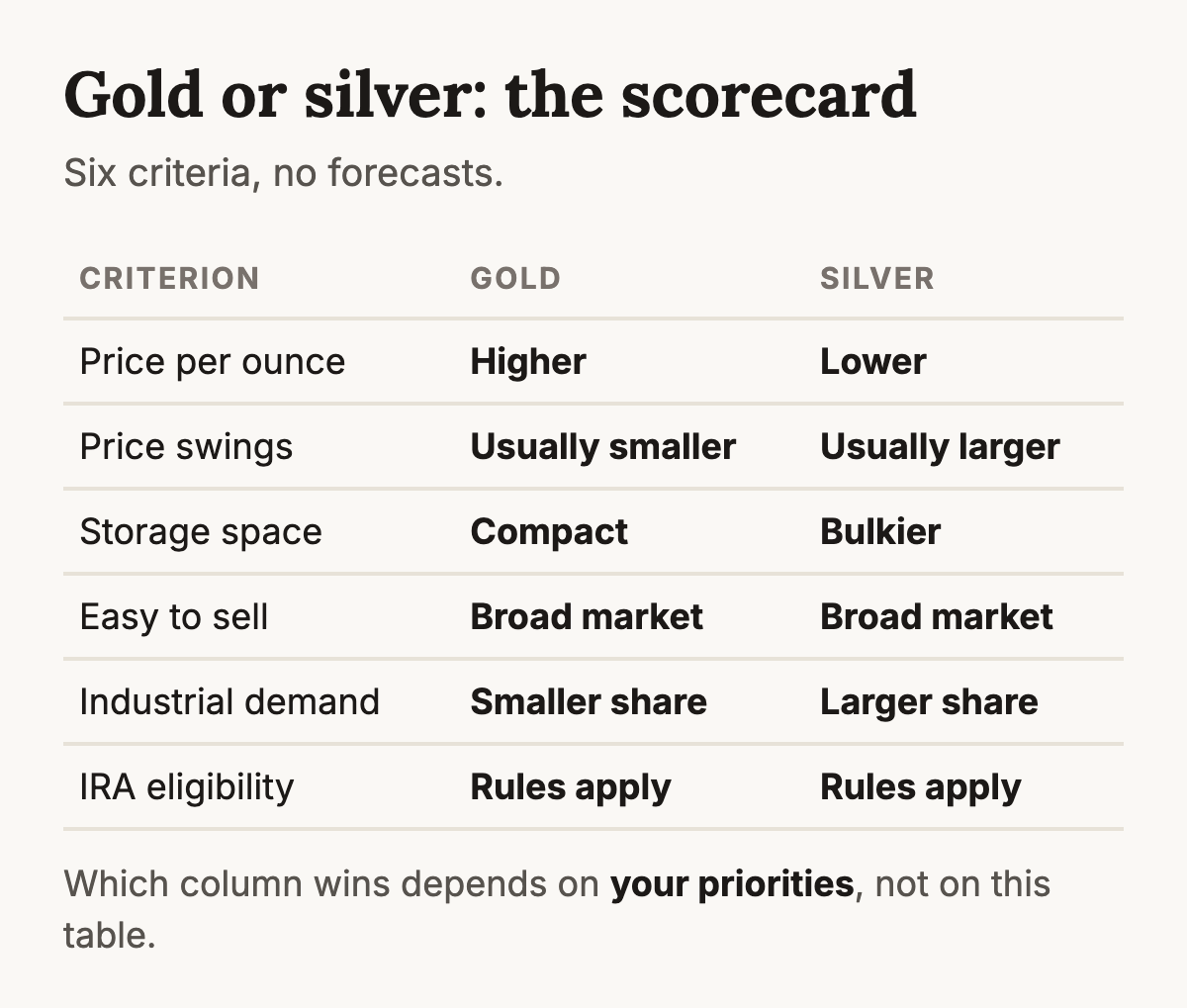
| Criterion | Gold | Silver |
|---|---|---|
| Price per unit | High: a single ounce costs a large sum | Low: a single ounce costs a small sum |
| Volatility | Generally the steadier of the two | Generally swings more in both directions |
| Storage space | Compact for the dollars held | Bulky for the same dollars |
| Liquidity | Widely traded, easy to value | Widely traded, but the weight adds friction |
| Industrial demand | Smaller share of demand | Larger share of demand |
| IRA eligibility | Strict purity rules, named coin exceptions | Strict purity rules, named coin exceptions |
1. Price per unit
Gold costs far more per ounce than silver, and that shapes everything downstream. A smaller account can buy a few ounces of gold or a lot of silver. Silver also comes in smaller dollar steps, so adding to an account in modest amounts is easier.
To see the effect with round numbers, here is an example only, not a current price. Say gold were $2,000 per troy ounce and silver were $25 per troy ounce. Then $10,000 would buy 5 ounces of gold or 400 ounces of silver, before any charges. The arithmetic is simple: $10,000 divided by $2,000 is 5, and $10,000 divided by $25 is 400.
A lower price per ounce does not make silver "cheaper" in any way that matters. You are buying the same amount of money's worth of metal either way. What differs is how many pieces you hold and how fine the steps are.
2. Volatility
Volatility means how far and how fast a price moves. Silver has historically moved more sharply than gold, up and down. A silver holding can gain or lose a bigger share of its value over a short window than a gold holding of the same dollar size.
That is a description of how the metals have behaved, not a forecast of how they will. Past swings say nothing certain about future ones. If large price drops would be hard for you to sit through, give more weight to this row.
3. Storage space
Because silver is cheaper per ounce, the same dollar amount of silver is a much larger pile of metal. Using the example above, 400 troy ounces of silver weighs about 12.4 kilograms (400 × 31.1035 grams), or roughly 27 pounds. Five troy ounces of gold weighs about 155 grams, a little over a third of a pound.
Inside an IRA you never carry that weight, but it still shows up. Depositories may price storage in ways that depend on the value held, the weight or the number of items, and the practices differ. Ask how a company charges for storage and whether the charge depends on value or on bulk. If you later take a distribution of the metal itself, silver is also the heavier thing to ship. Our silver by the pound guide works through what that weight looks like.
4. Liquidity
Liquidity is how easily you can turn an asset into cash at a fair price. Both metals are widely traded and widely recognized, and dealers quote both every day. Neither is a thinly traded curiosity.
The gap shows up in the mechanics. When a retirement saver sells, the metal has to be sold through the custodian. A large lot of silver means a lot of pieces to count and verify. Gold concentrates the same value in fewer pieces. Every sale also has a spread, the difference between what a dealer sells at and what it will pay to buy. Spreads vary by product and by dealer, so ask for the buyback terms in writing before you buy. Do not assume any company will take your metal back at a particular price.
5. Industrial demand
Gold is used in jewelry, electronics and as a store of value held by central banks and individuals. Silver is used in all of those too, and in a wide range of industrial products, from electronics to solar panels. The share of silver demand that comes from industry is larger than gold's.
What that means for you is limited. Industrial use can influence silver's price in ways that gold's does not share, which is part of why the two metals can move apart. It is a reason the metals are not twins, not a reason to expect a particular result.
6. IRA eligibility
Both metals face the same test. The tax code treats most collectibles, including "any metal or gem, any stamp or coin," as ineligible for IRAs. It then carves out exceptions, covered in the next section.
The practical point is that you cannot simply buy any gold or silver you like. The product has to qualify, and a reputable custodian will refuse an order that does not.
What the IRS rules actually allow
If you buy a collectible inside an IRA, the IRS treats the cost as a distribution to you in that year. For a traditional IRA, that distribution is generally taxed as ordinary income, and the 10% additional tax on early withdrawals can apply if you are under 59½. That is why eligibility matters more than it first looks.
The exceptions are in Internal Revenue Code section 408(m). We opened the statute and the IRS's own page to confirm the following:
- Certain U.S. coins. Gold coins described in 31 U.S.C. 5112(a) paragraphs (7) through (10), silver coins described in 31 U.S.C. 5112(e), and platinum coins described in 5112(k) are not treated as collectibles. The American Eagle coins are the familiar products in these groups. These coins are allowed by name in the law, which is why the gold American Eagle can qualify even though its gold content, 22 karat, is lower than the bar standard below.
- State-issued coins. Coins issued under the laws of a state are also excepted.
- Bullion of a minimum fineness. Gold, silver, platinum or palladium bullion qualifies if its fineness meets or exceeds the minimum that a regulated futures exchange requires for metal delivered against a futures contract, and the bullion is in the physical possession of the IRA trustee.
Fineness is purity, written as a decimal: .999 means 999 parts in 1,000. The statute points to the futures-exchange standard rather than printing a number. The figures widely applied in the industry are .995 for gold and .999 for silver. Treat those two figures as the commonly quoted working standard, and have your custodian confirm the current rule for any product you consider.
Two takeaways. First, the metal has to be held by the trustee, not by you, so the "gold in a home safe" idea does not work inside an IRA. Second, the coin exceptions let some products qualify that would not pass the purity test, so purity alone is not the full picture. Check each item against the custodian's approved list before ordering.
What history shows and does not show
People often compare the two metals with the gold-silver ratio. It is simply the price of gold divided by the price of silver. If gold is priced at 80 times silver, the ratio is 80. We do not print a current figure here, because it changes constantly and a number on a page goes stale.
Some people watch the ratio to decide which metal feels "cheap" relative to the other. That is a way of thinking, not a rule. The ratio has moved over wide ranges across history, and nobody can say with certainty which direction it takes next. A high or low ratio does not tell you what either price will do.
What history can show is the character of the two metals. Gold has tended to be the steadier of the pair. Silver has tended to move in larger swings, partly because industrial demand adds a second influence on its price. Those patterns are descriptions of the past. They are not a promise, and we make no forecast.
If a salesperson tells you a price will rise and uses that to hurry you, treat that as a red flag. Our best gold IRA companies page explains how we looked at what companies say before the sale, and why clarity ranked high.
The both-metals split
Many accounts hold both metals. Mechanically, a split is straightforward. You decide how much of the account goes to gold and how much to silver, for example by dollar amount or by percentage, and the custodian places one order for each. The depository holds them separately in your account record.
A few mechanics are worth knowing:
- Each purchase has its own charges. Two orders can mean two sets of dealer markups. Ask how a company prices each metal.
- Rebalancing is not free. If prices move and your mix drifts, selling one metal to buy the other involves spreads on both sides.
- The minimum still applies. A company's starting amount applies to the account, so a small account may be better off with one metal.
- Silver's bulk can add up. A large silver share means more pieces and more weight to store.
Notice what is missing: any statement of the right percentage. That is a personal decision. It depends on your age, your other savings, how much a price drop would worry you, and your tax situation. It belongs with a licensed professional who is not paid on the sale of metal, not with us and not with a salesperson. A company that earns money when you buy has a reason to lean toward whichever metal it sells most profitably.
Who tends to lean which way
These are tendencies, not recommendations.
Savers who lean toward gold are often those who value steadiness, want more value in fewer pieces, or are making a larger purchase. Gold's price per ounce is high, so a larger account suits it. Retirement savers closer to retirement tend to care more about swings, which is one reason gold appeals to them.
Savers who lean toward silver often have a smaller amount to start with, like the finer dollar steps, or are comfortable with bigger swings. Silver's industrial demand also appeals to people who like that it has uses beyond holding value. They accept the extra weight and storage that come with it.
Savers who choose both usually want to spread a position across two metals that do not move in lockstep. The cost is a more complicated account and more to explain to the custodian.
None of these groups is "right." If you do not yet know where you fall, a first purchase of one metal, with the option to add the other later, is one way people ease in. That, too, is a question for your licensed professional.
Practical differences when you buy
Once you have chosen, a few practical points differ by metal.
Products. Both metals come as coins and bars. Gold is usually bought in fractional and one-ounce coins and in small bars. Silver comes as one-ounce coins and rounds and in larger bars. Check each one against the custodian's list. A "round" is not a coin from a government mint, so confirm it qualifies.
Starting amounts. Company minimums matter more than the metal. Augusta Precious Metals publishes a $50,000 minimum for cash and IRA purchases. American Hartford Gold (AHG) publishes $10,000 for an IRA. Goldco's minimum is not published on the pages we checked, so ask Goldco. Those numbers come from each company's own site as of 2026-10-01, and they can change.
Storage. Augusta names the Delaware Depository. AHG names several depositories, including Brink's Global Services and Delaware Depository, and says storage is commingled unless you ask for segregated. Commingled means your metal is stored together with other clients' metal of the same kind. Segregated means yours is kept separate. Goldco says direct-purchase metal can be kept at home, in a safe deposit box or in a bullion depository, and did not name a depository on the pages we checked.
Custodian. Augusta and AHG both name Equity Trust Company. Goldco did not name a custodian on the pages we checked. Ask.
Buyback. Goldco says it will buy back metal bought from Goldco at any time, with no specific rate guaranteed. Augusta says it has never declined a buyback, and that this is not a guarantee. AHG says it cannot legally guarantee a repurchase. These are statements by the companies, not promises we have tested.
Charges. Charges differ and change, so ask each company for a written list before you sign. We explain the categories, without figures, in our guide to gold IRA fees.
If silver is your lean, our best silver IRA companies page looks at the same three companies through a silver lens.
Questions to ask before you pick
Take this short list to any call. It works for either metal.
- Which exact coins and bars would the order include, and are they on the custodian's approved list?
- Who is the custodian, and who is the depository?
- Is storage commingled or segregated, and how is the storage charge calculated?
- What is the buyback policy in writing, and what is the usual spread between buying and selling prices?
- What is the full list of one-time and yearly charges?
- Is there a minimum, and does it apply to each metal or to the account?
Write down the answers and compare them across companies. A company that answers plainly before the sale tends to keep doing so after it.
FAQ
Can I hold gold and silver in the same IRA?
Yes. Many precious metals IRAs hold both. You choose how to divide the account, and the custodian places an order for each metal. Each product still has to meet the IRS rules on its own, and your custodian will check each item against its approved list.
Which metal is better for a retirement account?
Neither is better for everyone. Gold is generally the steadier and more compact metal. Silver costs less per ounce but swings more and takes more room. The right mix depends on your age, other savings and comfort with price swings, so it is a question for a licensed professional who is not paid on the sale.
Does the IRS allow any gold or silver in an IRA?
No. Under IRC 408(m), most coins and metal are classed as collectibles and are not allowed. Exceptions cover certain U.S. coins described in 31 U.S.C. 5112, state-issued coins, and bullion of a minimum fineness held by the trustee. A custodian will confirm whether a given product qualifies.
What is the gold-silver ratio?
It is the price of gold divided by the price of silver. If gold is priced at 80 times silver, the ratio is 80. Some people watch it to compare the two metals. It does not forecast either price, and we do not print a current figure because it changes constantly.
Is silver a good choice if I only have a small amount?
Silver's lower price per ounce lets a smaller amount buy more pieces, and steps are finer. But company minimums, storage and shipping weight still apply. American Hartford Gold publishes a $10,000 IRA minimum, which is lower than the minimum Augusta publishes. Compare minimums and charges before deciding on a metal.
Can I keep the metal at home?
Not inside the IRA. For bullion to qualify under the statute, it has to be in the physical possession of the trustee. The IRS treats taking possession of IRA-held coins as a distribution, which can be taxable. Home storage applies to metal bought with cash, outside an IRA.
Will a mix of both metals protect me from price drops?
No. A mix spreads the account across two metals that do not always move together, but both can fall at once, and no mix removes that risk. We make no claim that a split will lower losses in any particular period.
General information only. This is not tax, legal or financial advice.
Sources
More guides
 Gold IRA
Best Gold IRA Companies for 2026: Matched to Your Situation
Which gold IRA company fits you? Augusta, Goldco and American Hartford Gold compared by starting amount, goal, storage and buyback policy. Gold IRA
Gold IRA Pros and Cons: Who It Suits and Who Should Skip It
A balanced look at gold IRA pros and cons: what the account does well, where it falls short, and the readers who are better off skipping it. Gold IRA
Gold IRA Fees Explained: Every Charge and How to Read It
Where the money goes in a gold IRA: setup, custodian, storage, markup and selling spread. Who charges each, and how to read a quote.Comparing companies? Our ranking sets Augusta Precious Metals, Goldco and American Hartford Gold side by side.
Compare the three companies