Gold IRA
Gold IRA Fees Explained: Every Charge and How to Read It

Quick answer: A gold IRA has five places where money leaves your account: a setup charge, a yearly custodian charge, a storage charge, the dealer's markup when you buy, and the spread when you sell. Three come from the custodian and depository, and two come from the dealer. Markup and spread are the least visible and often the largest. Ask for every charge in writing before you send anything.
Most people shopping for a gold IRA compare the visible charges and miss the invisible ones. A yearly account charge is easy to read on a price sheet. The gap between what a dealer sells a coin for and what the same dealer pays to buy it back is not printed on any statement, yet it shapes what you get back more than most line items do.
This guide walks through every charge in order, says who collects each one, explains how to read a quote, and ends with ten questions to put to any company in writing. It deliberately prints no dollar amounts or percentages. Costs differ between providers and change over time, so a number printed here would be stale or wrong for you. What does not change is the structure, and the structure is what lets you compare quotes fairly.
The five places money goes
Think of a gold IRA as a chain of four parties: you, a custodian, a depository and a dealer. The custodian is the financial company that holds the IRA itself and reports to the IRS. The depository is the secure vault where the metal sits. The dealer is the business that sells you the metal. Every link may charge you, and each charge has a different name.
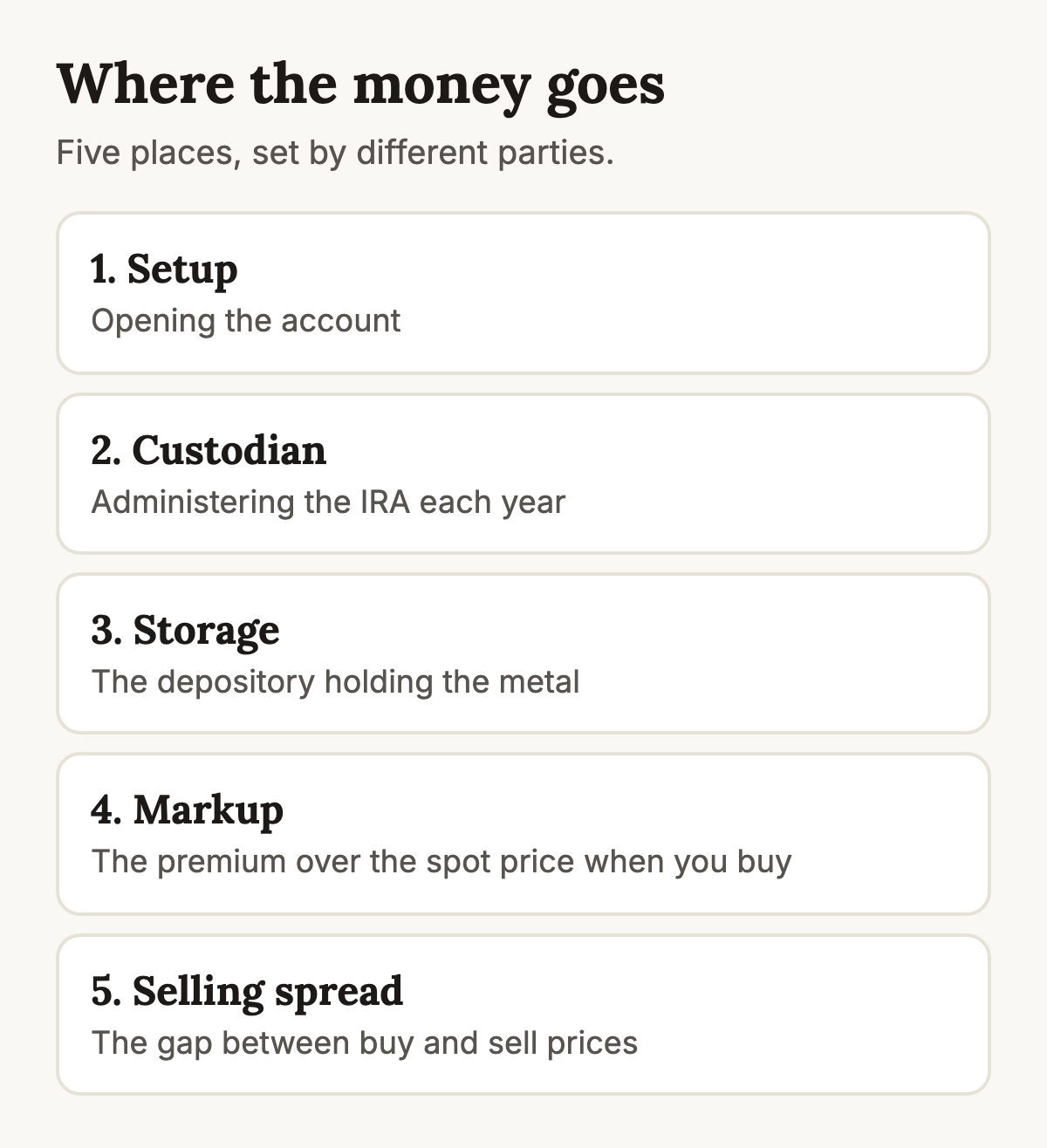
- Setup. A one-time charge to open the self-directed account, sometimes called an application or account-opening charge.
- Custodian. A recurring charge, usually yearly, for administering the account: record keeping, statements, tax reporting to the IRS.
- Storage. A recurring charge from the depository for holding and insuring your metal.
- Markup. The amount above the metal's market price that the dealer charges when you buy.
- Selling spread. The gap between the dealer's selling price and its buying price, which you feel when you sell or take the metal out.
The first three are fees in the ordinary sense: a named charge for a named service. The last two are built into the price of the metal and never appear as a separate bill. That difference is why a company can advertise low account charges and still be expensive overall, and why a high-looking account charge can sit beside a fair metal price.
Regulators list the same family of costs. The US Commodity Futures Trading Commission's consumer advisory on buying physical metals tells readers to ask what fees and commissions they will be charged, to consider other costs such as storage, insurance and administration, and to get all costs in writing before buying.
Who charges each
Keeping the chain straight helps you read a quote, because a single document often mixes charges from different parties.
The dealer sets the markup and the spread. It also sometimes charges for shipping or handling of the metal to the depository. If a company both sells the metal and arranges the account, the dealer's quote is the place to look for these two.
The custodian charges for setup and for yearly administration. Some custodians use a flat amount per account. Others scale the charge with the value of the account or with the number of different assets held. A custodian may also charge for specific actions, such as a transfer out, a distribution or a wire.
The depository charges for storage and insurance. Many bill this through the custodian, so on your statement it may appear under the custodian's name even though the vault set the price.
You pay all of it, but from where matters. Charges can be taken out of the IRA itself or paid separately from money outside the account. The IRS notes in Publication 590-A that trustee administrative fees billed separately and paid in connection with a traditional IRA are not deductible as IRA contributions and cannot be claimed as an itemized deduction. In plain terms, do not assume that paying a custodian charge from your own pocket earns a tax break. Ask a tax professional how it applies to you.
One practical point: a custodian does not vet the dealer. The CFTC says in its fraud warning on metals IRAs that custodians do not look into the assets or the people promoting them. So a clean custodian invoice tells you nothing about whether the dealer's price was fair. You have to check that yourself.
Flat or percentage?
Recurring charges come in two shapes, and which one you pay changes how your cost behaves over time.
A flat charge is a fixed amount per period, regardless of what the account is worth. The formula is simple:
yearly cost = flat amount
A percentage charge scales with the value of what is held:
yearly cost = account value x rate
Neither is better in every case. A flat structure tends to favor larger accounts, because the same amount is spread across more value. A percentage structure tends to favor smaller accounts, because the cost shrinks with the balance. The trouble is that metal prices move. If the price of gold rises and your charge is a percentage, your yearly cost rises with it, even though the vault did no extra work.
Many providers use a mix: a flat custodian charge plus a storage charge that depends on value or weight. Some price storage by the weight or volume of metal rather than its market value. That matters for silver, which is bulky for its worth, and it is one reason the guide to gold IRA versus silver IRA treats storage space as its own criterion.
When you compare two quotes, convert both to the same yearly formula. Write out what you would pay in the first year, including one-time charges, and what you would pay in later years. A quote that is cheap in year one because setup is waived, but costly each year after, is a different product from one with the reverse shape.
Also ask whether any charge can change. A rate that is fixed for the life of the account behaves differently from one the provider may revise with notice.
Segregated or commingled storage
Depositories hold metal in one of two ways, and the choice affects what you pay and what you get back.
In segregated storage, your metal is kept apart and recorded as yours. When you take it out, you receive the exact items you put in. In commingled storage, also called pooled or non-segregated, your metal is held together with other customers' metal of the same type, and you receive equivalent items of the same kind and weight when you leave.
Segregated storage generally costs more, because the vault does more handling and record keeping. Commingled storage generally costs less. Neither is a defect. For standard coins and bars, where one item is identical to another, commingled storage can be perfectly sensible. Segregated storage matters more if you want to be able to identify specific pieces.
What to ask:
- Which type is the default, and what does the other cost?
- Is the insurance the same in both cases, and who is the named insured?
- Can you see the vault's own records of what is held for you?
- Is there a charge to switch from one type to the other later?
Remember that the IRS requires IRA metal to be held by an approved custodian or trustee rather than at home, so some form of third-party storage is part of every gold IRA. You cannot opt out of storage to save the charge, which is also why buying outright and holding metal yourself is a different cost picture altogether.
How markup works
Markup is where most of the cost hides, and it is easy to understand once you see the formula.
Every metal has a spot price: the market price for immediate delivery of a troy ounce of the raw metal. The CFTC defines it that way in its consumer advisory. A coin or bar is not sold at spot. The dealer adds a premium to cover minting, distribution, handling and its own profit. So the price you pay is:
price paid = (spot price x weight in troy ounces) + premium
The metal portion moves with the market. The premium is the dealer's to set. Markup is the premium viewed as a share of the metal value:
markup = premium / (spot price x weight)
Here is a worked example using only symbols. Say you buy a coin of weight W, the spot price is S, and the dealer's premium is P. You pay S x W + P. The metal inside is worth S x W. The difference, P, is money you paid that does not show up as metal value. If you bought several coins, multiply each part by the number of coins.
Three things follow from the formula.
First, the premium is not the same across products. Common bullion coins from a national mint usually carry a lower premium than rare, collectible or specially packaged items. Dealers sometimes push buyers toward products with higher premiums. The CFTC advisory separates plain bullion from numismatic and semi-numismatic items, and the difference is worth asking about directly. Also note that the IRS does not generally allow collectibles in an IRA, with limited exceptions for certain bullion, so a high-premium collectible is often the wrong product for the account.
Second, a premium looks smaller on a heavy product because the same handling cost is spread over more metal. Compare premiums per unit of weight, not per item.
Third, you cannot judge a premium without the spot price and the time of the quote. Ask the dealer to write both on the order, with the weight, so you can run the formula yourself.
The selling spread
The spread is the other half of markup. Dealers buy below spot-based value and sell above it. The CFTC defines the spread as the difference between those two prices.
The selling spread is what you feel when you leave:
what you receive = (spot price x weight) - dealer's buyback discount
Because you paid spot plus a premium and you receive spot minus a discount, the market has to move in your favor by at least the combined gap before you break even on price. That is not a prediction about where gold goes. It is arithmetic, and it applies to every buyer at every dealer, so the only variable is how wide the gap is.
Two practical consequences. A dealer that sells at a low premium but buys back at a wide discount may cost more overall than one with a higher premium and a narrow discount. And a buyback promise is only as useful as its terms. Ask whether the buyback price is calculated from spot at the time of sale, whether there are conditions on how long you have held the metal, and whether the company will buy back items it did not sell you.
No dealer can promise a particular future price, and a company that says it can promise one is worth a second look. The pros and cons guide covers the selling gap among the downsides of the account.
Why published cost ranges disagree
If you search for what a gold IRA costs, you will find sources that contradict each other, sometimes sharply. This is not always because someone is lying. There are structural reasons.
- Different charges are counted. One source adds setup, custodian and storage. Another adds markup. A third includes the selling spread. They are not measuring the same thing.
- Providers set their own rates. Custodians and depositories price independently, and many do not publish a full schedule, so a range may be based on whichever few providers the author checked.
- Account size changes the answer. A flat charge is a large share of a small account and a small share of a large one, so a single range can be right for one reader and wrong for another.
- Rates change. A schedule copied from an old page may no longer apply, and websites are not always updated when providers revise their prices.
- Metal choice and storage type change the answer. Weight-based storage costs more for bulky metal, and segregated storage costs more than pooled.
- Some sources are paid. A page that is paid whenever a reader picks a company has a reason to make that company look cheap. Look for a disclosure on any page you read. This site currently carries no affiliate links, and it publishes no cost ranges because it tells you to get quotes in writing instead.
The practical rule: treat any single range as a rough idea at best and a quote addressed to you as the only number that counts. Get the same list of charges from every provider you consider, in the same format, and compare those.
Red flags in a quote
A quote can be legitimate and still be hard to read. These patterns call for slowing down:
- No itemization. A single bundled price, or vague labels such as "service charge" or "administrative cost" with no explanation of what they cover or who gets them.
- Pressure to act before you can read it. A quote that expires within the hour, or a salesperson who discourages you from taking it to a tax professional.
- Reluctance to put costs in writing. The CFTC advises asking for all costs in writing. A refusal is informative.
- A push toward collectibles. Rare or specially packaged coins carry larger premiums and, by IRS rules, are often not eligible for an IRA at all.
- Promises about the future. Guaranteed returns, guaranteed buyback prices, or claims that a metal "cannot lose value."
- Storage charges with no vault named. The CFTC warns that some fraudulent dealers charged storage and insurance for metal that never existed. You should be able to name the depository holding your metal and see it on your account statement.
- A premium that is hard to calculate. If you cannot reconstruct the price from spot, weight and premium, ask until you can.
The CFTC says that over the past decade it pursued cases involving large amounts of overpriced metals sold to retirees, and that in such schemes transaction costs and ongoing charges made it impossible for victims to profit. Most companies are not committing fraud, but the formula above is how you tell the difference.
A fee-quote checklist
Send these ten questions by email or ask the company to answer them on a written quote. A written answer is the point: it is something you can compare and refer back to.
- What is every one-time charge? Name each one, who collects it, and when it is due. Ask whether any of them is waived and under what conditions.
- What is the yearly custodian charge, and is it flat or based on value? Ask for the formula, not a single example.
- What does storage cost, and how is it calculated? Ask whether it depends on weight, volume or value, and whether the quote assumes segregated or commingled storage.
- Which custodian and which depository will be used? Get both names in writing so you can read their own price schedules.
- What is the spot price, the weight and the premium on each item? Ask for the order to show all three so you can rebuild the price.
- What is the buyback policy in writing? Ask how the buyback price is set, whether there is a minimum holding period, and what the discount from spot is, expressed as a formula.
- Which charges can change, and how will you be told? Ask whether rates are fixed or revisable and what notice you get.
- What do transfers, distributions and closing the account cost? Leaving is where many people first meet a charge they never saw.
- Are there shipping, insurance, wire or handling charges not listed above? Ask for a complete list and ask them to confirm it is complete.
- Who pays whom, and does anyone receive a commission on my purchase? Ask whether the salesperson, the dealer or any referrer is paid more for certain products.
If a company answers nine and dodges one, that is useful too. Keep the answers together, and compare providers on the same ten lines. For a view of how companies compare on the facts they publish, see the gold IRA company comparison.
FAQ
Is a gold IRA more expensive than a regular IRA?
Generally yes. A regular IRA at a brokerage can be inexpensive to run because the assets are standard securities held electronically. A gold IRA adds a dealer, a vault and a self-directed custodian, each with its own charge, and it adds the markup and spread that come with physical metal. Whether that extra cost is worth it depends on why you want the metal.
Which charge is the biggest?
It depends on the account. For many people the markup and selling spread outweigh the yearly charges over a few years, which is why they deserve the most attention. For a very small account, flat yearly charges can dominate. Run both through the formulas above with your own quote to see.
Are the charges tax deductible?
The IRS says in Publication 590-A that trustee administrative fees billed separately and paid in connection with a traditional IRA are not deductible as IRA contributions and cannot be itemized. Treatment of other costs varies by situation, so ask a tax professional.
Can a saver avoid storage charges by keeping the metal at home?
Not in an IRA. The IRS requires the metal to be held by an approved trustee or custodian, not by the owner. Home storage means buying the metal outside the IRA, which has different rules and costs. See the guide to buying by weight for that route.
Should the lowest listed charge decide the choice?
Not on that basis alone. A low account charge paired with a high premium or wide spread can cost more overall. Compare the full list of charges, using the ten questions above, and give weight to how clearly each company answers.
Why will no one give me one number for the total cost?
Because the total depends on account size, metal, storage type, how long you hold and when you sell. A company can give you each charge and a formula. If it will not, that is worth noting.
Where can a saver report a dealer suspected of overcharging?
The CFTC and the Federal Trade Commission both take reports about metals dealers, and your state securities regulator may also help. Keep your written quote and order confirmation.
General information only. This is not tax, legal or financial advice.
Sources
More guides
 Gold IRA
Best Gold IRA Companies for 2026: Matched to Your Situation
Which gold IRA company fits you? Augusta, Goldco and American Hartford Gold compared by starting amount, goal, storage and buyback policy. Gold IRA
Gold IRA vs Silver IRA: A Scorecard to Decide in 2026
Gold, silver or both in an IRA? Score the two metals on price, volatility, storage, liquidity and demand, then see how a split works. Gold IRA
Gold IRA Pros and Cons: Who It Suits and Who Should Skip It
A balanced look at gold IRA pros and cons: what the account does well, where it falls short, and the readers who are better off skipping it.Comparing companies? Our ranking sets Augusta Precious Metals, Goldco and American Hartford Gold side by side.
Compare the three companies