Silver
Best Silver IRA Companies for 2026: What Silver Changes
A silver IRA is the same kind of account as a gold IRA, but silver behaves differently once real metal has to be counted, shipped and stored. Choosing a company for silver means asking a few extra questions about weight, vault space and how the metal is delivered. This guide covers what silver changes and how Augusta Precious Metals, Goldco and American Hartford Gold (AHG) compare when silver is the goal.
Quick answer: For silver, the company matters less than the questions you ask it. Silver is cheap per ounce, so a given amount of money buys far more weight than gold, which affects shipping, storage and how the order is counted. Of the three companies we compare, Augusta ranks first, Goldco second and American Hartford Gold third. Ask each for its starting amount, depository and buyback terms in writing.
What makes a silver IRA different
In a silver IRA, you direct the account yourself, and it can hold physical silver in place of, or next to, stocks and funds. The account itself works the way a gold IRA does. A custodian, which is the financial firm that holds the account on your behalf and files the paperwork, administers it. A dealer sells you the metal. A depository, which is an approved vault, stores it. You cannot keep the metal at home, because the IRS treats metal taken into your own possession differently from metal held by a trustee. For the basics of that structure, see our guide to choosing a gold IRA company, which explains the same four roles in more detail.
What changes is the metal. An ounce of silver costs a small fraction of what an ounce of gold costs. That one fact cascades into everything else on this page. The same budget produces many more coins or bars. The metal takes up more room in a vault. A shipment is heavier. A sale later involves more pieces to count and verify.
Silver also tends to attract a different kind of buyer. Some people come to it because they want a lower price per unit and a smaller first purchase. Others like that it is used in manufacturing as well as held as a store of value. We do not predict which metal will rise or fall, and nothing here is a recommendation to buy silver. If you are still deciding between the metals, our gold IRA vs silver IRA scorecard lays out the trade-offs side by side.
There is also a practical effect on the numbers you see. Many companies state a starting amount in dollars, not in ounces. A starting amount that looks modest in gold terms becomes a large pile of silver. Keep that in mind when you read the sections below.
Which silver qualifies for an IRA
Not every piece of silver can go into an IRA. The tax code treats most coins as collectibles, and an IRA that acquires a collectible is treated as having paid out the cost of it to the owner. The IRS says on its plan assets page that IRAs cannot hold collectibles such as art, antiques, gems, certain coins or alcoholic beverages, and that they can hold certain precious metals only if they meet specific requirements.
The specific requirements sit in Section 408(m) of the Internal Revenue Code. The text of that section carves out an exception, provided the metal is in the physical possession of a trustee. The exception covers American Eagle silver coins, certain state-issued coins, and bullion in gold, silver, platinum or palladium that meets the fineness standards of a regulated commodity exchange.
In plain terms, that gives you two broad families of silver:
- Government-issued coins named in the law, such as American Eagle silver coins.
- Bullion bars and rounds that meet the required fineness. Fineness is purity, written as a decimal. For silver, the figure most dealers and custodians quote is .999, which means 99.9 percent pure silver. Confirm the standard your custodian applies.
Collectible and rare coins do not qualify, even when they contain silver. A coin priced for its age or scarcity, and not for its metal, is the classic example. If a salesperson steers you toward coins that are valued for rarity, treat that as a reason to stop and ask whether the coin is eligible. The wording in the law is narrow on purpose.
Two cautions follow. First, we are describing the rule in general terms, and the details of what a given custodian accepts can be narrower than the law. Ask the custodian for its list of approved products before you place an order. Second, eligibility is separate from price. A coin can be eligible and still carry a large premium over the value of its metal, which is one reason to read the quote closely. Our guide to how costs work in a gold IRA explains how premiums and spreads show up in a quote, and the same logic applies to silver.
Silver's volume problem
Here is the part that silver changes most. Because silver costs so much less per ounce, the same dollars buy far more ounces. More ounces mean more weight, more pieces and more space.
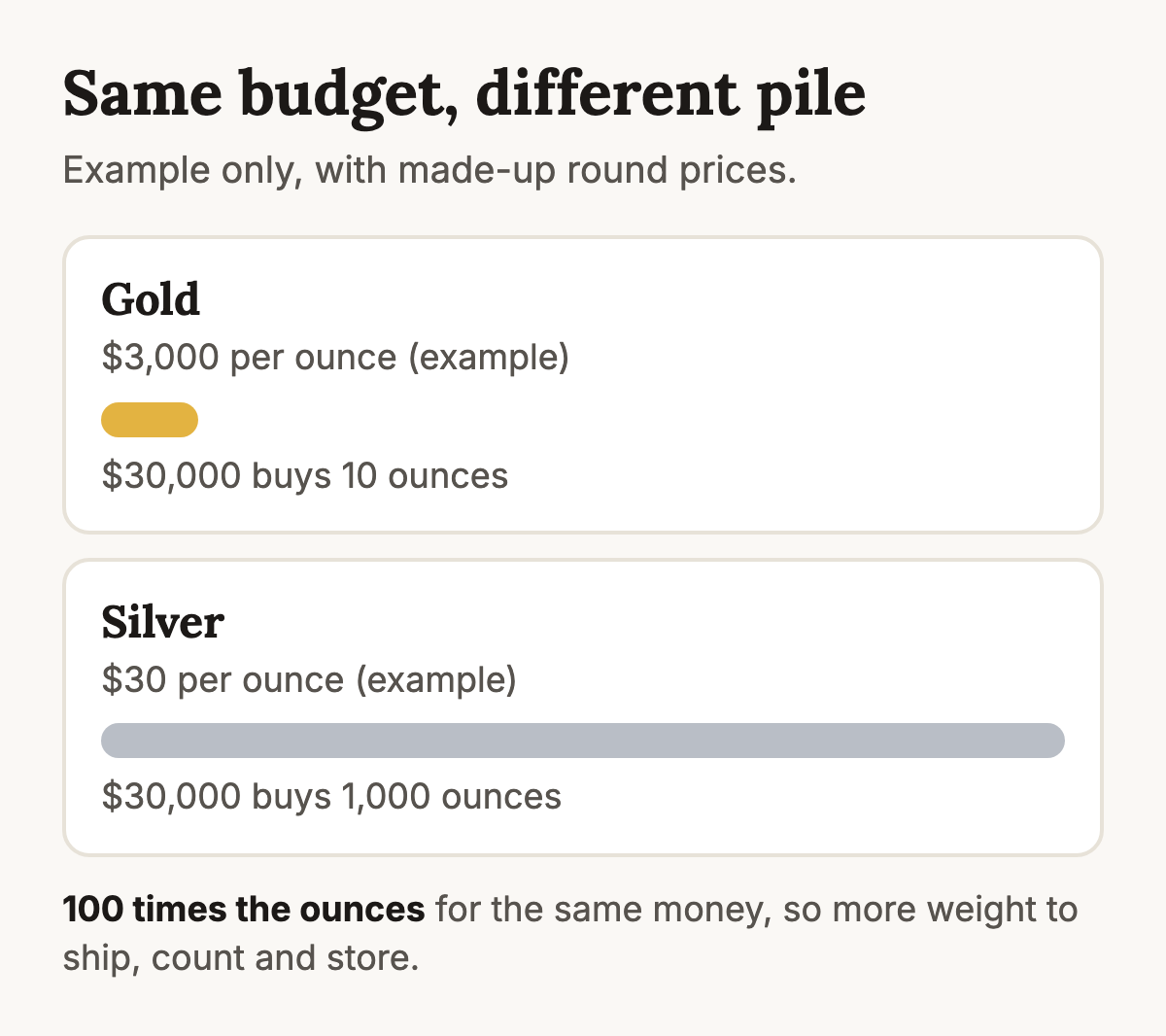
The arithmetic is simple. Divide the dollars you are putting in by the price of one ounce, and you get the number of ounces:
ounces = dollars ÷ price per ounce
Here is an example only, not a current price. Suppose silver costs $30 an ounce and gold costs $3,000 an ounce, both round numbers chosen to make the math easy. Put $50,000 into each metal.
| Silver (example) | Gold (example) | |
|---|---|---|
| Price per ounce (example only) | $30 | $3,000 |
| Ounces bought with $50,000 | 1,666.7 | 16.7 |
| Ratio | 100 times as many ounces | 1 |
That is 100 times as many ounces of silver. Both metals are measured in troy ounces, so the weight scales the same way. A troy ounce is the unit precious metals are weighed in, and it is a little heavier than the ounce on a kitchen scale. There are 14.5833 troy ounces in an everyday pound, a figure we work through in our silver by the pound guide. Dividing the example 1,666.7 ounces by 14.5833 gives about 114 pounds of silver, against about 1 pound of gold for the same money.
Silver is also less dense than gold, so the difference in the space it takes up is wider than the weight difference suggests. We are not stating a density figure here, but the direction is clear: a silver purchase of this size fills real shelf space.
The practical consequences are these:
- Shipping. A heavy shipment is more expensive to ship and insure, and it is usually sent in several boxes. Ask who pays, who insures, and when your ownership begins during transit.
- Storage. A depository may charge by the value held, by the space used, or by a mix. Weight and volume can matter more for silver than for gold. Ask how your storage cost is worked out, in writing.
- Counting and verification. More pieces mean more to count on arrival and on sale. Ask how the depository reports your holdings, and whether you receive an itemized list.
- Rounding. Coins and bars come in set sizes. Some amounts of money will not divide neatly, so a small amount may be left unspent.
None of this makes silver a poor choice. It means the logistics are a bigger part of the decision than they are with gold, and that a company with clear answers on logistics deserves extra weight.
If your purchase will be held outside an IRA, the tax picture is different. The IRS notes in its Topic 409 that net capital gains from selling collectibles such as coins or art are taxed at a maximum rate of 28 percent. Inside a properly run IRA, the account's own tax rules apply instead. Ask a licensed tax professional which situation you are in.
How we judged the companies on silver
We ranked the three companies using the same weighting as the rest of the site: track record 30 percent, clarity before the sale 25 percent, buyback 15 percent, storage 15 percent and starting amount 15 percent. The ranking is editorial. No company was tested, and we did not place an order with any of them.
For silver we added a lens to each criterion:
- Track record. How long the company has been operating and how the Better Business Bureau rates it, as published on its profile.
- Clarity before the sale. Whether the company publishes the details a silver buyer needs, such as the custodian, the depository and the starting amount, before you speak to a salesperson.
- Buyback. What the company says about buying your metal back, since a larger pile of silver is harder to sell in a hurry.
- Storage. Which depositories are named and whether you can choose how the metal is held.
- Starting amount. The minimum purchase the company publishes, because silver reaches that number in a very different quantity of metal.
One limit applies to everything below. The facts we use come from what each company publishes on its own site, checked on 2026-10-01, plus its Better Business Bureau profile. None of those pages sets out a separate silver-only policy, so where silver differs, the right move is to ask the company directly and get the answer in writing.
The three companies on silver
1. Augusta Precious Metals (score 4.9)
Augusta opened in 2012 and is rated A+ by the Better Business Bureau, with accreditation since February 2015. It sells gold and silver coins and bars, and it ships cash purchases anywhere in the U.S. as well as selling for IRAs. It names its custodian, Equity Trust Company, and its depository, Delaware Depository.
For a silver buyer, the main point is the starting amount. Augusta publishes a $50,000 minimum, which applies to cash and IRA purchases alike. Using the example arithmetic above, a purchase of that size in silver is a lot of metal, so the shipping and storage questions in this guide are not theoretical for an Augusta buyer. Augusta also says it has never declined a buyback, while noting that no dealer can guarantee one and that the policy can change.
Augusta suits buyers making a larger purchase who want the process explained before they commit. If your budget is below the minimum, it is not the right fit.
2. Goldco (score 4.8)
Goldco's Better Business Bureau profile shows a business start in October 2011 and an A+ rating, accredited since December 2011, the longest of the three. It sells gold and silver coins, for both IRAs and direct purchases.
Its buyback wording is the most specific of the three. Goldco states that it will repurchase metal it sold you whenever you ask. Its "highest price" pledge begins only after three years have gone by from the first order, and it promises no particular rate.
For silver, Goldco's gap is that its minimum, its custodian and its depository are not published on the pages we checked. It says direct-purchase metal can be kept at home, in a safe deposit box or in a bullion depository, without naming one. That matters more with a bulky metal, because the depository's rules shape how your silver is stored. If you are considering Goldco, ask for the starting amount, the custodian's name and the depository's name before anything else. Goldco is the pick for buyers whose main worry is the eventual sale, and who are happy to gather the specifics on a call.
3. American Hartford Gold (score 4.7)
AHG began operating in 2015 and is rated A+ by the Better Business Bureau, which has accredited it since June 2016. It sells gold and silver coins, bars and rounds, for IRAs and for home delivery. It publishes the lowest starting amount of the three: $10,000 for an IRA. Its cash minimum is not published, so ask.
AHG names several depositories, including Brink's Global Services and Delaware Depository, though its pages differ on the full list, so confirm which ones apply. Storage is commingled by default and segregated on request. Commingled storage means your metal is pooled with other customers' metal of the same kind, while segregated storage keeps yours separate. With silver, where the piles are larger, it is worth asking how each option works and how it is counted. Equity Trust Company is its custodian. On buyback, AHG asks clients to contact it first when selling and says it cannot legally guarantee a repurchase.
AHG fits someone making a smaller first purchase, or anyone who wants some choice over which vault holds the metal.
Side by side
| Augusta | Goldco | AHG | |
|---|---|---|---|
| Rank and score | 1 (4.9) | 2 (4.8) | 3 (4.7) |
| Better Business Bureau | A+ | A+ | A+ |
| Published minimum | $50,000 | Not published | $10,000 (IRA) |
| Silver coins and bars | Yes | Yes | Yes, plus rounds |
| Depository | Delaware Depository | Independent, not named | Several named, confirm list |
| Custodian | Equity Trust Company | Not named | Equity Trust Company (Entrust as alternative) |
| Buyback wording | Never declined one, not guaranteed | Any time, "highest price" after three years | Cannot legally guarantee |
Read the table as a starting point for questions, not a verdict. Companies change their terms, so confirm each item directly.
Storage and shipping questions to ask
Because silver is bulky, the questions below carry more weight than they would for gold. Put them to any company in writing, and keep the answers.
- Who is the depository, and is it named in your paperwork? A depository should be a named, approved vault, not a general description.
- Is storage commingled or segregated, and what does each cost? Ask for the pricing method in words, whether it is flat, percentage-based or tied to space.
- How is my silver counted and reported? Look for an itemized statement, not just a dollar value.
- How does the metal travel, and who is responsible in transit? Ask who insures the shipment and at what point it becomes yours.
- What happens at sale time? Ask how many days it takes, how the sale price is set, and whether the company or the depository ships the metal.
- Can a distribution be taken in metal? If you want to take silver out of the account later, ask how that works and what the paperwork involves. Taking a distribution has tax consequences, so ask a licensed professional first.
- Which products are approved? Ask for the custodian's current list, and check that every coin and bar on your order is on it.
- What is the spread at sale time? The spread is the gap between what you pay to buy and what you receive when you sell. Silver's lower price per ounce can make the spread a larger share of the total than it is with gold, so ask how it is set.
If any answer is vague, say so and ask again. A company that is clear on these points before you buy is usually clear afterward too.
Gold, silver or both?
Many retirement savers do not choose one metal. A mixed account holds some gold and some silver, and the account can be changed later. How much of each is a personal decision that depends on your goals, your time horizon and your tolerance for price swings, and it is one to take to a licensed professional who is not paid on the sale.
Mechanically, a mix is easy. The same custodian and depository usually handle both metals, and the dealer fills one order for each. The difference is in the logistics: the silver portion is the heavy one. Our gold IRA vs silver IRA guide walks through a scorecard of the two metals, and our pros and cons of a gold IRA shows where the account itself falls short, which applies to silver as well.
Red flags when buying silver
Watch for these, with any company:
- Pressure to decide today. A real purchase can wait a day for you to read the paperwork.
- Collectible or "rare" coins pitched for an IRA. The law is narrow, and a coin valued for rarity may not qualify.
- A starting amount that changes between the website and the phone call. Ask for the figure in writing.
- No named custodian or depository. Both should be named before you sign.
- Promises about future prices. Nobody can know them, and a firm that claims to is not giving you general information.
- Vague buyback language. Ask what the sale price is based on, and how long it takes.
- Claims that you can store IRA silver at home. Metal held in an IRA is held by a trustee, not by you.
If something feels wrong, you can check a company's Better Business Bureau profile, and you can report fraud to the Federal Trade Commission or the Commodity Futures Trading Commission.
FAQ
Is silver a good fit for an IRA?
It can be, but it is not for everyone. Silver costs less per ounce than gold, so a given amount buys more weight, which changes shipping and storage. It can also swing more in price. Whether it suits you depends on your goals and is a question for a licensed professional who is not paid on the sale.
What silver can go in an IRA?
The tax code allows American Eagle silver coins and bullion that meets a commodity-exchange fineness standard, held by a trustee. For silver, the figure most dealers and custodians quote is .999 purity. Rare and collectible coins are generally not allowed. Ask your custodian for its current approved list.
Can IRA silver be kept at home?
No. The metal must be in the physical possession of a trustee, which in practice means an approved depository. Metal you take into your own hands is treated differently by the IRS, and doing so can have tax consequences.
Which of the three companies has the lowest starting amount?
Among the amounts the companies publish, American Hartford Gold lists $10,000 for an IRA and Augusta lists $50,000. Goldco's minimum is not published on the pages we checked, so ask Goldco directly. Cash purchase minimums may differ from IRA minimums.
Why does silver take up so much more space than gold?
Per ounce, silver is a small fraction of gold's price, which means a given budget buys a far larger count of ounces. In our example, $50,000 buys about 1,667 ounces of silver and about 17 ounces of gold. Silver is also less dense, so the same weight fills more room.
Are the rankings paid for?
No. The ranking follows the weighting described above, no company was tested or ordered from, and this site currently carries no affiliate links. Read our homepage ranking and the about page for how we work.
Is it better to buy silver in an IRA or outright?
Each has trade-offs. An IRA changes how the metal is taxed and requires a custodian and a depository. Buying outright gives you the metal at home, and the IRS notes that net capital gains from selling collectibles such as coins can be taxed at up to 28 percent. A licensed tax professional can tell you which fits your situation.
General information only. This is not tax, legal or financial advice.
Sources
More guides
 Silver
Silver by the Pound: How to Buy a Pound of Silver in 2026
A pound of silver is 14.5833 troy ounces, not 12. See the forms, weight, storage, paperwork and mistakes before you buy a pound of silver. Gold IRA
Best Gold IRA Companies for 2026: Matched to Your Situation
Which gold IRA company fits you? Augusta, Goldco and American Hartford Gold compared by starting amount, goal, storage and buyback policy. Gold IRA
Gold IRA vs Silver IRA: A Scorecard to Decide in 2026
Gold, silver or both in an IRA? Score the two metals on price, volatility, storage, liquidity and demand, then see how a split works.Comparing companies? Our ranking sets Augusta Precious Metals, Goldco and American Hartford Gold side by side.
Compare the three companies